


Page 6 - September Open Access Content
P. 6
TECHNICAL PAPER


         3.2 Concrete Mix Design                                4.2 Fresh and Hardened concrete Properties
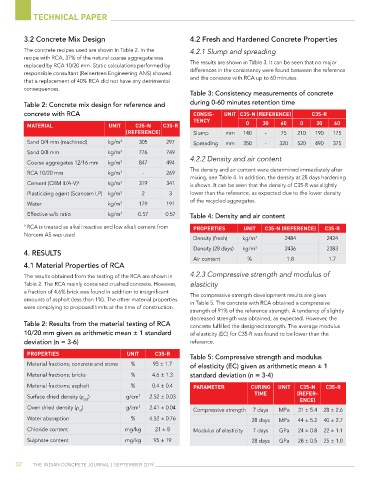
         The concrete recipes used are shown in Table 2. In the   4.2.1 Slump and spreading
         recipe with RCA, 37% of the natural coarse aggregate was
         replaced by RCA 10/20 mm. Static calculations performed by   The results are shown in Table 3. It can be seen that no major
         responsible consultant (Reinertsen Engineering ANS) showed   differences in the consistency were found between the reference
         that a replacement of 40% RCA did not have any detrimental   and the concrete with RCA up to 60 minutes.
         consequences.
                                                                table 3: Consistency measurements of concrete
         table 2: Concrete mix design for reference and         during 0-60 minutes retention time
         concrete with RcA                                       consIs-   UnIt c35-n (rEfErEncE)       c35-r
                                                                 tEncy
          MAtErIAl                   UnIt     c35-n    c35-r                      0     30    60    0     30    60
                                           (rEfErEncE)           Slump      mm    140    -    75   210   190   175

          Sand 0/4 mm (machined)     kg/m 3    305      297      Spreading  mm    350    -   320   520   490   375
          Sand 0/8 mm                kg/m 3    776      749
                                                                4.2.2 Density and air content
          Coarse aggregates 12/16 mm  kg/m 3   847      494
                                                                The density and air content were determined immediately after
          RCA 10/20 mm               kg/m 3     -       269
                                                                mixing, see Table 4. In addition, the density at 28 days hardening
          Cement (CEM II/A-V) a      kg/m 3    319      341     is shown. It can be seen that the density of C35-R was slightly
          Plasticizing agent (Scancem LP) kg/m 3  2      3      lower than the reference, as expected due to the lower density
                                                                of the recycled aggregates.
          Water                      kg/m 3    179      191
          Effective w/b ratio        kg/m 3    0.57     0.57    table 4: Density and air content
         a  RCA is treated as alkali reactive and low alkali cement from   ProPErtIEs  UnIt  c35-n (rEfErEncE)  c35-r
         Norcem AS was used
                                                                 Density (fresh)  kg/m 3       2484          2424
                                                                 Density (28 days)  kg/m 3     2436          2383
         4. ResUlts
                                                                 Air content       %            1.8           1.7
         4.1 Material Properties of RcA
         The results obtained from the testing of the RCA are shown in   4.2.3 Compressive strength and modulus of
         Table 2. The RCA mainly contained crushed concrete. However,   elasticity
         a fraction of 4.6% brick was found in addition to insignificant   The compressive strength development results are given
         amounts of asphalt (less than 1%). The other material properties   in Table 5. The concrete with RCA obtained a compressive
         were complying to proposed limits at the time of construction.
                                                                strength of 91% of the reference strength. A tendency of slightly
                                                                decreased strength was obtained, as expected. However, the
         table 2: Results from the material testing of RcA      concrete fulfilled the designed strength. The average modulus
         10/20 mm given as arithmetic mean ± 1 standard         of elasticity (EC) for C35-R was found to be lower than the
         deviation (n = 3-6)                                    reference.
          ProPErtIEs                       UnIt     c35-r
                                                                table 5: compressive strength and modulus
          Material fractions; concrete and stone  %  95 ± 1.7
                                                                of elasticity (ec) given as arithmetic mean ± 1
          Material fractions; bricks        %      4.6 ± 1.3    standard deviation (n = 3-4)
          Material fractions; asphalt       %      0.4 ± 0.4     PArAMEtEr          cUrIng   UnIt   c35-n    c35-r
                                                                                     tIME          (rEfEr-
          Surface dried density (ρ )       g/cm 3  2.52 ± 0.03
                             ssd                                                                    EncE)
          Oven dried density (ρ )          g/cm 3  2.41 ± 0.04
                           rd                                    Compressive strength  7 days  MPa  31 ± 5.4  28 ± 2.6
          Water absorption                  %     4.52 ± 0.76                       28 days  MPa    44 ± 5.2  40 ± 2.7
          Chloride content                mg/kg     21 ± 8       Modulus of elasticity  7 days  GPa  24 ± 0.8  22 ± 1.1
          Sulphate content                mg/kg     95 ± 19                         28 days  GPa    28 ± 0.5  25 ± 1.0


      32    The IndIan ConCreTe Journal | SepTember 2019

