


Page 5 - Open-Access-Nov-2019
P. 5
TECHNICAL PAPER


         1.2 Dampers                                            •   Grade of concrete used M 40
         1.2.1 Fluid viscous dampers                            •   Column size 750 mm X 750 mm
         Fluid viscous dampers are most commonly used as a passive   •   Beam size 230 mm X 450 mm
         energy dissipation device. It consists of a hollow cylinder filled   •   Shear wall thickness 200 mm
         with a viscous liquid, silicone is mostly the type of fluid used   •   Thickness of outrigger wall 500 mm
         in these kinds of dampers. The damper piston rod pushes the
         piston head making the fluid to flow through the orifices either   •   Slab thickness 230 mm
         around or through the piston head. The fluid flows at high   •   Live load 3kN/m 2
         velocities which results in the development of friction between
         fluid particles and the piston head. The friction forces developed   •   Height of each story 3.5 m
         will result in energy dissipation in the form of heat.  •   Total height of the structure 210 m

         2. OBJeCtIves OF PReseNt wORK
         This research work is focused on analyzing the performance of
         the outrigger structural system with dampers. The objectives of
         the present study are as follows.
         •   To study the performance of a structure with one and two
             outriggers located at their optimum location with dampers.
         •   To study the performance by varying the flexural rigidity
             ratio viz:(flexural rigidity of core wall with respect to the
             flexural rigidity of the outrigger) with dampers.
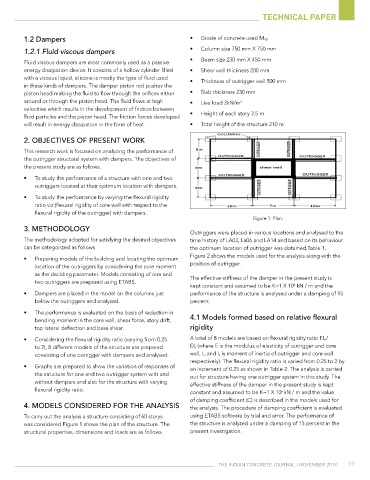
                                                                                     Figure 1: Plan.

         3. MetHODOLOGY
                                                                Outriggers were placed in various locations and analysed to the
         The methodology adopted for satisfying the desired objectives   time history of LA03, La06 and LA14 and based on its behaviour
         can be categorized as follows                          the optimum location of outrigger was obtained,Table 1,

         •   Preparing models of the building and locating the optimum   Figure 2 shows the models used for the analysis along with the
             location of the outriggers by considering the core moment   position of outrigger.
             as the deciding parameter. Models consisting of one and   The effective stiffness of the damper in the present study is
             two outriggers are prepared using ETABS.
                                                                kept constant and assumed to be K=1 X 10  kN / m and the
                                                                                                  6
         •   Dampers are placed in the model on the columns just   performance of the structure is analysed under a damping of 15
             below the outriggers and analysed.                 percent.
         •   The performance is evaluated on the basis of reduction in
             bending moment in the core wall, shear force, story drift,   4.1 Models formed based on relative flexural
             top lateral deflection and base shear.             rigidity
         •   Considering the flexural rigidity ratio (varying from 0.25   A total of 8 models are based on flexural rigidity ratio EI o/
             to 2), 8 different models of the structure are prepared   EI s (where E is the modulus of elasticity of outrigger and core
             consisting of one outrigger with dampers and analysed.  wall, I o and I s is moment of inertia of outrigger and core wall
                                                                respectively). The flexural rigidity ratio is varied from 0.25 to 2 by
         •   Graphs are prepared to show the variation of responses of   an increment of 0.25 as shown in Table-2. The analysis is carried
             the structure for one and two outrigger system with and   out for structure having one outrigger system in this study. The
             without dampers and also for the structure with varying   effective stiffness of the damper in the present study is kept
             flexural rigidity ratio.                           constant and assumed to be K=1 X 10 kN / m and the value
                                                                                              6
                                                                of damping coefficient (C) is described in the models used for
         4. MODeLs CONsIDeReD FOR tHe ANALYsIs                  the analysis. The procedure of damping coefficient is evaluated
         To carry out the analysis a structure consisting of 60 storys   using ETABS software by trial and error. The performance of
         was considered Figure 1 shows the plan of the structure. The   the structure is analyzed under a damping of 15 percent in the
         structural properties, dimensions and loads are as follows.  present investigation.


                                                                         The IndIan ConCreTe Journal | november 2019  17

