


Page 5 - Open-Access-Mar-2020
P. 5
TECHNICAL PAPER


               %QPETGVG s  /
               4GKPHQTEGOGPV s (G
               ..     M0 O   5+&.       M0 O

               %QXGT VQ DGCO CPF UNCD      OO
                                                          ; "     E E
                                            ; "     E E               ; "     E E
                  /CUQPT[ RKNNCT
                                              OO


                                                                ; "    E E
                                       ; "     E  E
                                                               OO       OO
                     & U
                                                              D  5GEVKQP # #  %QPXGPVKQPCN FGUKIP


             $                      #                     ; "     E E

                                             ; "     E E
                                                                      ; "     E E
                                             OO


                                                                 ; "     E  E
                                                              ; "     E E
                                             OO
                                                               E  5GEVKQP # #  2TQRQUGF FGUKIP
                       C  2NCP
                                                                                     #NN FKOGPUKQPU CTG KP OO

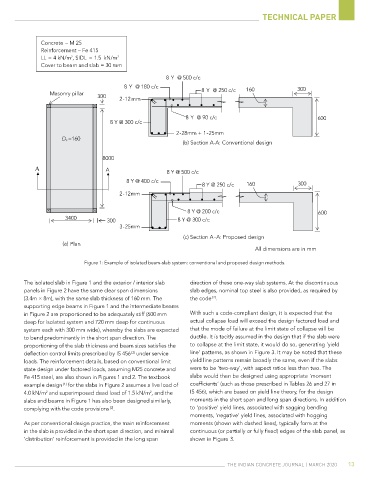
                             Figure 1: Example of isolated beam-slab system: conventional and proposed design methods.


         The isolated slab in Figure 1 and the exterior / interior slab   direction of these one-way slab systems. At the discontinuous
         panels in Figure 2 have the same clear span dimensions    slab edges, nominal top steel is also provided, as required by
                                                                        [2]
         (3.4m × 8m), with the same slab thickness of 160 mm. The   the code .
         supporting edge beams in Figure 1 and the intermediate beams
         in Figure 2 are proportioned to be adequately stiff (600 mm   With such a code-compliant design, it is expected that the
         deep for isolated system and 720 mm deep for continuous   actual collapse load will exceed the design factored load and
         system each with 300 mm wide), whereby the slabs are expected   that the mode of failure at the limit state of collapse will be
         to bend predominantly in the short span direction. The   ductile. It is tacitly assumed in the design that if the slab were
         proportioning of the slab thickness and beam sizes satisfies the   to collapse at the limit state, it would do so, generating ‘yield
                                             [2]
         deflection control limits prescribed by IS 456  under service   line’ patterns, as shown in Figure 3. It may be noted that these
         loads. The reinforcement details, based on conventional limit   yield line patterns remain broadly the same, even if the slabs
         state design under factored loads, assuming M25 concrete and   were to be ‘two-way’, with aspect ratios less than two. The
         Fe 415 steel, are also shown in Figures 1 and 2. The textbook   slabs would then be designed using appropriate ‘moment
         example design  for the slabs in Figure 2 assumes a live load of   coefficients’ (such as those prescribed in Tables 26 and 27 in
                       [1]
                2
                                                   2
         4.0 kN/m  and superimposed dead load of 1.5 kN/m , and the   IS 456), which are based on yield line theory, for the design
         slabs and beams in Figure 1 has also been designed similarly,   moments in the short span and long span directions. In addition
         complying with the code provisions .                   to ‘positive’ yield lines, associated with sagging bending
                                      [2]
                                                                moments, ‘negative’ yield lines, associated with hogging
         As per conventional design practice, the main reinforcement   moments (shown with dashed lines), typically form at the
         in the slab is provided in the short span direction, and minimal   continuous (or partially or fully fixed) edges of the slab panel, as
         ‘distribution’ reinforcement is provided in the long span   shown in Figure 3.


                                                                            The IndIan ConCreTe Journal | MarCh 2020  13

