


Page 5 - August Open Access Content
P. 5
TECHNICAL PAPER


         main load-bearing component in a building frame, appropriate   based columns with and without steel fibers, respectively. Except
         fire safety provision must be satisfied. Therefore, it is necessary   for the strength and fiber reinforcement, these columns had
         to evaluate the response of the SFRC columns under fire   similar characteristics, aggregate type, and were tested under
         conditions.                                            similar load levels.
                                                                               P
         The advances in numerical models and computational tools,
         and an improved knowledge of elevated temperature material   47.5                610 × 508 × 25 steel Plate
         properties, have made it possible to determine the fire                       ties @ 145 mm c/c
         resistance of structural members through calculations with     600                  4-25 φ  8 mm φ
         sufficient accuracy. A review of literature indicates that, while                                 75
         several numerical studies  [6, 13, 14]  are available in the literature
         for evaluating the fire resistance of the NSC columns, very                                           305
         few numerical studies  [6, 15]  are available for the SFRC columns.                        152.5
         Moreover, the available numerical models either neglect the                                  75
                                                                                                      305
         contribution of the SFRC or use a simplified approach to    3810  2465
         account for the contribution and high temperature properties of
         the SFRC. Thus, these numerical models do not provide insights
         on the fire performance of the SFRC columns. To overcome
         some of these drawbacks and to evaluate the fire response
                                                                                      ties @ 145 mm c/c
         of the SFRC columns, a numerical model is presented in this
         paper. The validity of the model is established by comparing the
         temperature and deflection predicted by the model with those
         measured in fire tests. Additionally, the behavior of the NSC and   600      610 × 508 × 25 steel Plate
         HSC columns under fire exposure is analyzed and compared      47.5
         with the fire behavior of the SFRC columns.                                          (All dimensions are in mm)
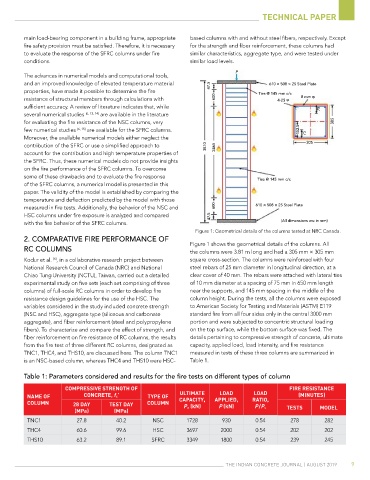
                                                                  Figure 1: Geometrical details of the columns tested at NRC Canada.
         2. coMPARAtive FiRe PeRFoRMANce oF
                                                                Figure 1 shows the geometrical details of the columns. All
         Rc coLUMNs                                             the columns were 3.81 m long and had a 305 mm × 305 mm
         Kodur et al.  , in a collaborative research project between   square cross-section. The columns were reinforced with four
                   [6]
         National Research Council of Canada (NRC) and National   steel rebars of 25 mm diameter in longitudinal direction, at a
         Chiao Tung University (NCTU), Taiwan, carried out a detailed   clear cover of 40 mm. The rebars were attached with lateral ties
         experimental study on five sets (each set comprising of three   of 10 mm diameter at a spacing of 75 mm in 650 mm length
         columns) of full-scale RC columns in order to develop fire   near the supports, and 145 mm spacing in the middle of the
         resistance design guidelines for the use of the HSC. The   column height. During the tests, all the columns were exposed
         variables considered in the study included concrete strength   to American Society for Testing and Materials (ASTM) E119
         (NSC and HSC), aggregate type (siliceous and carbonate   standard fire from all four sides only in the central 3000 mm
         aggregate), and fiber reinforcement (steel and polypropylene   portion and were subjected to concentric structural loading
         fibers). To characterize and compare the effect of strength, and   on the top surface, while the bottom surface was fixed. The
         fiber reinforcement on fire resistance of RC columns, the results   details pertaining to compressive strength of concrete, ultimate
         from the fire test of three different RC columns, designated as   capacity, applied load, load intensity, and fire resistance
         TNC1, THC4, and THS10, are discussed here. The column TNC1   measured in tests of these three columns are summarized in
         is an NSC-based column, whereas THC4 and THS10 were HSC-  Table 1.

         Table 1: Parameters considered and results for the fire tests on different types of column
                       ComPREssIvE stREnGtH oF                                                   FIRE REsIstAnCE
          nAmE oF            ConCREtE, f c’       tYPE oF   ULtImAtE      LoAD       LoAD           (mInUtEs)
          CoLUmn         28 DAY      tEst DAY     CoLUmn    CAPACItY,   APPLIED,    RAtIo,
                                                                         P (kn)
                                                              P u (kn)
                          (mPa)        (mPa)                                         P/P u      tEsts      moDEL
          TNC1            27.8         40.2        NSC         1728        930        0.54       278        282
          THC4            60.6         99.6         HSC        3697       2000        0.54       202        202
          THS10           63.2         89.1        SFRC        3349       1800        0.54       239        245


                                                                            The IndIan ConCreTe Journal | auGuST 2019  9

