


Page 6 - August Open Access Content
P. 6
TECHNICAL PAPER


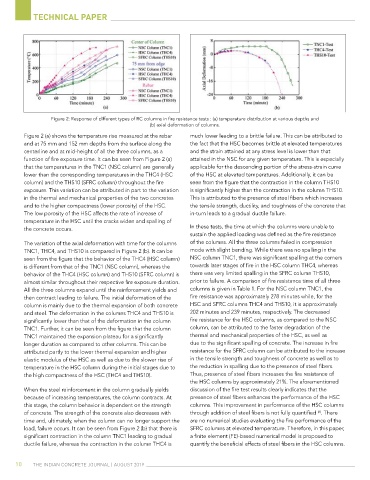
                  Figure 2: Response of different types of RC columns in fire resistance tests : (a) temperature distribution at various depths and
                                                   (b) axial deformation of columns.
         Figure 2 (a) shows the temperature rise measured at the rebar   much lower leading to a brittle failure. This can be attributed to
         and at 75 mm and 152 mm depths from the surface along the   the fact that the HSC becomes brittle at elevated temperatures
         centerline and at mid-height of all the three columns, as a   and the strain attained at any stress level is lower than that
         function of fire exposure time. It can be seen from Figure 2 (a)   attained in the NSC for any given temperature. This is especially
         that the temperatures in the TNC1 (NSC column) are generally   applicable for the descending portion of the stress-strain curve
         lower than the corresponding temperatures in the THC4 (HSC   of the HSC at elevated temperatures. Additionally, it can be
         column) and the THS10 (SFRC column) throughout the fire   seen from the figure that the contraction in the column THS10
         exposure. This variation can be attributed in part to the variation   is significantly higher than the contraction in the column THS10.
         in the thermal and mechanical properties of the two concretes   This is attributed to the presence of steel fibers which increases
         and to the higher compactness (lower porosity) of the HSC.   the tensile strength, ductility, and toughness of the concrete that
         The low porosity of the HSC affects the rate of increase of   in-turn leads to a gradual ductile failure.
         temperature in the HSC until the cracks widen and spalling of
         the concrete occurs.                                   In these tests, the time at which the columns were unable to
                                                                sustain the applied loading was defined as the fire resistance
         The variation of the axial deformation with time for the columns   of the columns. All the three columns failed in compression
         TNC1, THC4, and THS10 is compared in Figure 2 (b). It can be   mode with slight bending. While there was no spalling in the
         seen from the figure that the behavior of the THC4 (HSC column)   NSC column TNC1, there was significant spalling at the corners
         is different from that of the TNC1 (NSC column), whereas the   towards later stages of fire in the HSC column THC4, whereas
         behavior of the THC4 (HSC column) and THS10 (SFRC column) is   there was very limited spalling in the SFRC column THS10,
         almost similar throughout their respective fire exposure duration.   prior to failure. A comparison of fire resistance time of all three
         All the three columns expand until the reinforcement yields and   columns is given in Table 1. For the NSC column TNC1, the
         then contract leading to failure. The initial deformation of the   fire resistance was approximately 278 minutes while, for the
         column is mainly due to the thermal expansion of both concrete   HSC and SFRC columns THC4 and THS10, it is approximately
         and steel. The deformation in the columns THC4 and THS10 is   202 minutes and 239 minutes, respectively. The decreased
         significantly lower than that of the deformation in the column   fire resistance for the HSC columns, as compared to the NSC
         TNC1. Further, it can be seen from the figure that the column   column, can be attributed to the faster degradation of the
         TNC1 maintained the expansion plateau for a significantly   thermal and mechanical properties of the HSC, as well as
         longer duration as compared to other columns. This can be   due to the significant spalling of concrete. The increase in fire
         attributed partly to the lower thermal expansion and higher   resistance for the SFRC column can be attributed to the increase
         elastic modulus of the HSC as well as due to the slower rise of   in the tensile strength and toughness of concrete as well as to
         temperature in the HSC column during the initial stages due to   the reduction in spalling due to the presence of steel fibers.
         the high compactness of the HSC (THC4 and THS10).      Thus, presence of steel fibers increases the fire resistance of
                                                                the HSC columns by approximately 21%. The aforementioned
         When the steel reinforcement in the column gradually yields   discussion of the fire test results clearly indicates that the
         because of increasing temperatures, the column contracts. At   presence of steel fibers enhances the performance of the HSC
         this stage, the column behavior is dependent on the strength   columns. This improvement in performance of the HSC columns
                                                                                                          [6]
         of concrete. The strength of the concrete also decreases with   through addition of steel fibers is not fully quantified  . There
         time and, ultimately, when the column can no longer support the   are no numerical studies evaluating the fire performance of the
         load, failure occurs. It can be seen from Figure 2 (b) that there is   SFRC columns at elevated temperature. Therefore, in this paper,
         significant contraction in the column TNC1 leading to gradual   a finite element (FE)-based numerical model is proposed to
         ductile failure, whereas the contraction in the column THC4 is   quantify the beneficial effects of steel fibers in the HSC columns.


      10    The IndIan ConCreTe Journal | auGuST 2019

