


Page 5 - Open-Access-Sep-2019
P. 5
TECHNICAL PAPER


         aggregates in concrete is accepted in many countries and   is observed including at early age. In order to overcome the
         significant amount of research have been conducted with good   reduction in the mechanical properties observed in concrete
         understanding on the properties of concrete containing these   containing recycled aggregates and those containing high
         recycled aggregates and SCM materials.                 volume fly ash and slag in the above studies, one promising
                                                                approach is to use ultrafine pozzolanic materials e.g. silica fume,
         The construction industry in Australia is a fast-growing industry   nano silica and other ultrafine materials. This paper presents
         due to the increasing demand for infrastructure as a result of   the effect of nano silica and ultrafine fly ash on compressive
         increase in population growth in recent and coming years,   and indirect tensile strengths of recycled aggregate concretes
         predicted to be 72% between 2007 and 2030 (Hyder consulting,   measured from early (7 days) to later ages (91 days) and the
         2009), as well as the anticipated growth and demand for   effect of silica fume on the compressive and indirect tensile
         infrastructure in the future. Construction and demolition   strengths of recycled aggregate concretes containing high
         (C&D) waste accounts for about 40% of Australia’s solid waste   volume fly ash and slag as partial replacement of cement. In
         materials, with 160 million tonnes of virgin aggregates being   addition, the effect of inclusion of SCMs and nano silica on
         mined every year (Australia’s sustainable aggregates industry,   the carbon footprint of recycled aggregate concrete is also
         2012). In 2008 a total of 19 million tonnes of C&D waste was   analysed.
         disposed of in Australia. Only 10.5 million tonnes, or 55%,
         of this waste was recycled or recovered, leaving 45%, or 8.5   2. ExpEriMEntal prograM
         million tonnes, of waste sent to landfills around Australia. With
         increasing target recovery of C&D wastes in future and the   Materials
         shortage of natural aggregates in some parts of the world, there   Ordinary Portland Cement (OPC) was used in all mixes. The fly
         is a need to develop recycled aggregates from C&D waste as an   ash used in this study was class F fly ash, while the blast furnace
         alternative source of aggregates.
                                                                slag used in this study was obtained from a local supplier.
         In order to further improve the environmental friendliness of   Commercial Silica Fume (SF) supplied by Ecotec was used in this
         concrete and to maximise the use of SCM and C&D wastes in
         concrete the use of high volume fractions of these materials
         in concrete need to be incorporated. Significant amount of
         research is also conducted on the individual use of high volume
         fractions of SCM in concrete. Numerous researches on both
         mechanical and durability properties of recycled aggregate
         concretes have also been conducted (Chen et al. 2003; Yong
         and Teo 2009; Zhang and Ingham 2010; Xiao et al. 2005; Yang
         et al. 2008; Tam et al. 2006; Padmini et al. 2009; Ahmed 2013).
         It is shown that the old adhered mortars in recycled aggregates
         are more porous than that of natural coarse aggregates and
         micro crack exists in recycled aggregates due to crushing and
         grinding during their manufacturing (Etxeberria et al. 2006; Katz
         2004). Moreover, the interfacial transition zone (ITZ) between
         the old mortar and the old aggregate are also porous and weak
         (Otsuki et al. 2003; Poon et al. 2004). Those factors are claimed
         to be responsible for inferior properties of recycled aggregate
         concretes. The SCM can reduce these pores and micro cracks
         through pore filling due to their finer particle sizes than OPC as
         well as the formation of additional hydration product (calcium
         silica hydrate (CSH)) through pozzolanic reaction in concrete.
         A number of studies have evaluated the effect of fly ash on the
         properties of concrete containing recycled aggregates (Somna
         et al., 2012, Ahmed, 2013 and 2014, Corinaldesh and Moriconi,
         2009, Kou et al., 2007 and 2013) and the effect of slag on the
         properties of concrete containing recycled aggregates (Kou et
         al., 2011, Ann et al., 2008, Cakir, 2014, Majhi et al., 2018). In all
         the reported studies on the use of fly ash and slag in concrete
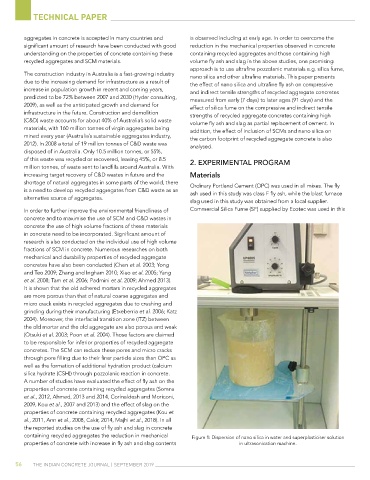
         containing recycled aggregates the reduction in mechanical   Figure 1: Dispersion of nano silica in water and superplasticiser solution
         properties of concrete with increase in fly ash and slag contents      in ultrasonication machine.


      56    The IndIan ConCreTe Journal | SepTember 2019

