


Page 6 - Open-Access-Sep-2019
P. 6
TECHNICAL PAPER
table 1: chemical composition and physical properties of binder materials
chEMIcAl oPc UltrAfInE clAss f fly Ash sIlIcA fUME (sf) slAg nAno
AnAlysIs (wt. %) fly Ash (UffA) (fA) (wt.%) (wt. %) sIlIcA (ns)
(wt. %) (wt. %) (wt. %)
SiO 2 20.2 73.4 63.13 89.6 32.45 99
Al 2O 3 4.9 17.7 24.88 - 13.56 -
Fe 2O 3 2.8 4.4 3.07 - 0.82 -
CaO 63.9 0.9 2.58 - 41.22 -
MgO 2.0 0.6 0.61 - 5.1 -
K 2O - 1.03 2.01 0.225 0.35 -
Na 2O - 0.11 0.71 0.11 0.27 -
SO 3 2.4 0.2 0.18 - 3.2 -
LOI 2.4 0.6 1.45 3.8 1.11 -
Physical properties
Particle size 25 - 40% ≤ 7 µm Mean size 3.4 µm 73% particles < 45 µm 95% particles < 1 mm - 25 nm
Specific gravity 2.7 to 3.2 2.0 to 2.55 2.68 0.625 - 2.2-2.6
Surface area - 2.51 1.53 15-30 - 160
2
(m /g)
study. The SF was densified and amorphous with specific surface and RCA used in this study were in saturated and surface dry
area of about 15–30 m /kg. The Nano Silica (NS) was obtained condition before used in the mixing.
2
from Nanostructured and Amorphous Materials, Inc., USA, with
2
average particle dia. of 25 nm and surface area of 160 m /g. The table 2: Properties of aggregates
NS was in powder form with purity of 99% silicon dioxide (SiO2).
The specific gravity was within the range of 2.2–2.6 (Shaikh et al., ProPErtIEs MEAsUrED rcA ncA
2014). Commercially available ultrafine fly ash (UFFA) was also
used in this study. The properties and chemical compositions Water Absorption (%) 4.88% 0.45%
of fly ash, slag, UFFA, NS, SF and OPC are shown in Table 1. Uncompacted Bulk density (kg/m ) 1700 2000
3
Rheobuild 1000, high-range water reducer, was added to the
3
mixes containing NS, UFFA and SF. In the case of mix containing Compacted Bulk density (kg/m ) 1900 2400
NS, the NS powder was added into 1 litre of water containing
superplasticiser and this was placed in an ultrasonic dispersion
machine, as shown in Figure 1, for 30 min to disperse the
particles evenly and to prevent the agglomeration when added 2% 6.00
3%
to the concrete mix. 3% 6.00 6.00
5.00 5.00
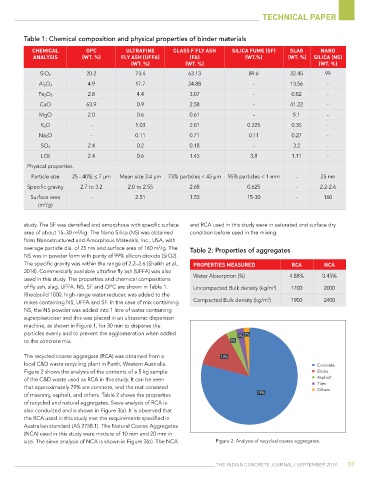
The recycled coarse aggregate (RCA) was obtained from a 13% 4.00 4.00 5.00
local C&D waste recycling plant in Perth, Western Australia. Concrete 7d Tensile strength (Mpa) 3.00 4.00
Figure 2 shows the analysis of the contents of a 5 kg sample Bricks Tensile strength (Mpa) 3.00 28d 2.00 7d Tensile strength (Mpa) 3.00 7d
28d
of the C&D waste used as RCA in this study. It can be seen Asphalt 2.00 56d 1.00 56d 2.00 28d
0.00
that approximately 79% are concrete, and the rest consisted Tiles 91d 91d 56d
Others
of masonry, asphalt, and others. Table 2 shows the properties 79% 1.00 1.00
of recycled and natural aggregates. Sieve analysis of RCA is 0.00
0.00
also conducted and is shown in Figure 3(a). It is observed that Control 50RCA 50RCA50FA50RCA50Slag Control 50RCA 50RCA2NS 50RCA10UFFA
the RCA used in this study met the requirements specified in Mix types Mix types Mix types
Australian standard (AS 2758.1). The Natural Coarse Aggregates
(NCA) used in this study were mixture of 10 mm and 20 mm in
size. The sieve analysis of NCA is shown in Figure 3(b). The NCA Figure 2: Analysis of recycled coarse aggregates.
70
60 The IndIan ConCreTe Journal | SepTember 2019 57 70 70 450
60
60
400
Compressive strength (Mpa) 40 7d Compressive strength (Mpa) 40 0 7d Compressive strength (Mpa) 40 7d CO2 emission (Kg CO2e) 300
50
50
50
350
30
30
250
20
28d
28d
20
30
28d
200
56d
10
56d
10
91d
20
150
56d
0
91d
100
10
50
0
Control 50RCA 50RCA50FA50RCA50Slag Mix types 0
Mix types Control 50 RCA 50 RCA+50 Slag 50 RCA+50 Fly ash
Mix types Types of mixes
500
450 450
CO2 emission (Kg CO2e) 350 CO2 emission (Kg CO2e) 350
400
400
300
250
300
200
250
150
100
150
50 200
0 100
50 50 50 50 50 50 50 50 50 50
RCA RCA+50 RCA+50 RCA+50 RCA+50 RCA+50 RCA+50 RCA+50 RCA+50
Slag Slag+5 SF Slag+10 Slag+15 Fly ash Fly ash+5 Fly ash Fly ash 0
SF SF SF +10 SF +15 SF
Control 50 RCA 50 RCA+2 NS
Types of mixes
Types of mixes

