


Page 5 - Open Access - Oct 2019
P. 5
1200
Hydrocarbon fire
1.2
ISO 834 fire
1.0
1.0
1.0
1.0
1000
1000
Calcareous
ASTM E119 fire
aggergate
aggergatess
Temperature (ºC)
0.8
0.8
0.8
0.8
800
800
External fire
aggergate
aggergatess
0.6
0.6
0.6
0.6
600
600
fsp,f
fsp,f
0.4
0.4
0.4
0.4
400
400
0.2
0.2
0.2
0.2
200
200
0.0
0.0
0.0
0.0
800
400
0
150
18
180
1500
120
0 Temperature (ºC) 1200 ISO 834 fire 90 Hydrocarbon fire External fire ASTM E119 fire fck,f Stress fck,f Stress fsy,f Stress fsy,f Stress fck,f / fck 1.2 0 fck,f / fck Siliceous Siliceous 400 Calcareous 800 1200 1200 fct,f / fct 1.2 0 fct,f / fct 1.2 0 200 200 400 400 600 600
60
12
60
900
30
0 30
Time (Minutes) co,f co,f cu,f Strain Strain sp,f sp,f sy,f sy,f st,f st,f su,f Strain Strain T (°C) T (°C) T (°C) T (°C)
Time (Minutes)
cu,f
su,f
point of view
1200 Hydrocarbon fire 12 12 2.5 2.5 1.2 1.2 1.2 1.2 1.2 1.2 1.2
1.2
Stress Stress
ISO 834 fire
1000 10 10 1.0 Calcareous 1.0 1.0 1.0 1.0 1.0 1.0
1.0
Hot-rolled
ASTM E119 fire fck,f fsy,f 8 2.0 2.0 aggergates 0.8 0.8 Hot-rolled 0.8 0.8 Hot-rolled 0.8 0.8
Temperature (ºC) 600 External fire co,f / co 6 fsp,f co,f / co 6 cu,f / cu 1.5 cu,f / cu fck,f / fck 1.5 aggergates fsp,f / fsp 0.6 fsp,f / fsp fct,f / fct 0.6 fsy,f / fsy 0.6 fsy,f / fsy Cold-worked Es,f / Es 0.6 Es,f / Es 0.6 Cold-worked
Hot-rolled
0.8
0.8
8
800
Cold-worked
Siliceous
Cold-worked
0.6
0.6
0.6
1.0
1.0
0.4
4
0.4
4
400
Cold-worked
Hot-rolled
0.5 0.5 0.4 0.4 Cold-worked 0.4 0.4 0.4 0.4 Hot-rolled
2 2 0.2 0.2 0.2 0.2 0.2
0.2
200 0.2 0.2
0 0 0.0 0.0 0.0 0.0 0.0 0.0 0.0 0.0 0.0
0.0
600
1200
800
400
800 1200
0 30 60 90 120 150 180 0 0 400 400 800 800 1200 1200 0 0 0 400 400 400 800 800 1200 1200 0 0 0 400 200 800 400 1200 0 0 400 400 800 800 1200 1200 0 0 400 400 800 800 1200 1200
T (°C)
Time (Minutes) co,f cu,f Strain sp,f sy,f T (°C) T (°C) st,f su,f Strain T (°C) T (°C) T (°C) T (°C) T (°C) T (°C) T (°C) T (°C)
T (°C)
(a) (b)
12 2.5 1.2 1.2 1.2 of structures already exposed to fire. The material modelling of
concrete and steel has been discussed. The variation of main
10 2.0 1.0 1.0 Hot-rolled 1.0 critical parameters of concrete and steel with temperature has
Hot-rolled been presented. It is recommended that the material modelling
8 0.8 0.8 0.8
1.5 Cold-worked under elevated temperature should be incorporated in the
co,f / co 6 cu,f / cu fsp,f / fsp 0.6 fsy,f / fsy 0.6 Cold-worked Es,f / Es 0.6 relevant design standards in India. These guidelines would
1.0 be quite helpful to practicing engineers and designers in
4 0.4 0.4 0.4
Cold-worked understanding the fire resistance design of structures.
0.5 Hot-rolled
2 0.2 0.2 0.2
references
0 0.0 0.0 0.0 0.0
0 400 800 1200 0 400 800 1200 0 400 800 1200 0 400 800 1200 0 400 800 1200 [1] fib Model Code for Concrete Structures 2010, International
T (°C) T (°C) T (°C) T (°C) T (°C) Federation for Structural Concrete (fib), Lausanne,
Switzerland, 2013.
(c)
[2] Bhatt P., Kodur V., Matsagar V. (2019), " Numerical Approach
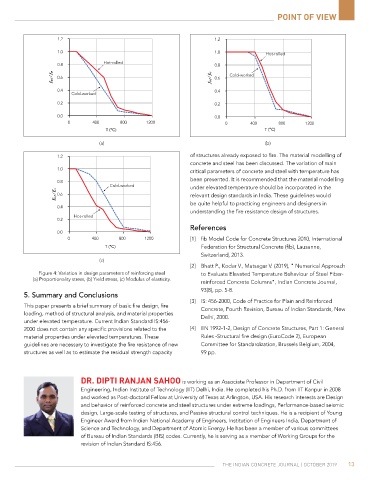
Figure 4: Variation in design parameters of reinforcing steel to Evaluate Elevated Temperature Behaviour of Steel Fiber-
(a) Proportionality stress, (b) Yield stress, (c) Modulus of elasticity.
reinforced Concrete Columns", Indian Concrete Journal,
93(8), pp. 5-8.
5. summary and conclusions
[3] IS: 456-2000, Code of Practice for Plain and Reinforced
This paper presents a brief summary of basic fire design, fire Concrete, Fourth Revision, Bureau of Indian Standards, New
loading, method of structural analysis, and material properties Delhi, 2000.
under elevated temperature. Current Indian Standard IS:456-
2000 does not contain any specific provisions related to the [4] EN 1992-1-2, Design of Concrete Structures, Part 1: General
material properties under elevated temperatures. These Rules -Structural fire design (EuroCode 2), European
guidelines are necessary to investigate the fire resistance of new Committee for Standardization, Brussels Belgium, 2004,
structures as well as to estimate the residual strength capacity 99 pp.
dr. dipti ranjan sahoo is working as an Associate Professor in Department of Civil
Engineering, Indian Institute of Technology (IIT) Delhi, India. He completed his Ph.D. from IIT Kanpur in 2008
and worked as Post-doctoral Fellow at University of Texas at Arlington, USA. His research interests are Design
and behavior of reinforced concrete and steel structures under extreme loadings, Performance-based seismic
design, Large-scale testing of structures, and Passive structural control techniques. He is a recipient of Young
Engineer Award from Indian National Academy of Engineers, Institution of Engineers India, Department of
Science and Technology, and Department of Atomic Energy. He has been a member of various committees
of Bureau of Indian Standards (BIS) codes. Currently, he is serving as a member of Working Groups for the
revision of Indian Standard IS:456.
The IndIan ConCreTe Journal | oCToBer 2019 13

