


Page 6 - Open Access - November
P. 6
TECHNICAL PAPER


         table 1: design area of BrB core segments in the strengthened frames
             frame         V BrB (kn)    l BrB (mm)        Ø            t (kn)         a BrB (m )     k BrB (kn/m)
                                                                                             2
          4-Story           107.2          3440           54.5           77.8          0.00035          41.34
          8-Story           116.4          4118           60.9           84.4          0.00038          44.87
          20-Story          956.6          4118           60.9          694.2          0.00311          308.26


         table 2: Axial yield and ultimate strengths of BrB of strengthened frames
             frame           P yt (kn)       ∆ yt (m)      P yc (kn)       ∆ yc (m)       P ut (kn)      P uc (kn)
          4-Story             86.4           0.0021         95.1           0.0023          121.0          133.1
          8-Story             93.8           0.0021         103.2          0.0023          131.3          144.5
          20-Story            771.3          0.0025         848.4          0.0028         1079.8         1187.8


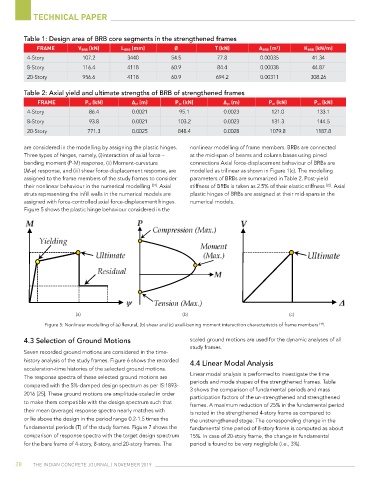
         are considered in the modelling by assigning the plastic hinges.   nonlinear modelling of frame members. BRBs are connected
         Three types of hinges, namely, (i)interaction of axial force –   at the mid-span of beams and column bases using pined
         bending moment (P-M) response, (ii) Moment-curvature    connections Axial force-displacement behaviour of BRBs are
         (M-ψ) response, and (iii) shear force-displacement response, are   modelled as trilinear as shown in Figure 1(c). The modelling
         assigned to the frame members of the study frames to consider   parameters of BRBs are summarized in Table 2. Post-yield
                                                                                                             [22]
                                                   [24]
         their nonlinear behaviour in the numerical modelling  . Axial   stiffness of BRBs is taken as 2.5% of their elastic stiffness  . Axial
         struts representing the infill walls in the numerical models are   plastic hinges of BRBs are assigned at their mid-spans in the
         assigned with force-controlled axial force-displacement hinges.   numerical models.
         Figure 5 shows the plastic hinge behaviour considered in the


                          (a)                                (b)                                 (c)
                                                                                                           [19]
                Figure 5: Nonlinear modelling of (a) flexural, (b) shear and (c) axail-bening moment interactiion characteristcis of frame members  .

         4.3 Selection of Ground Motions                        scaled ground motions are used for the dynamic analyses of all
                                                                study frames.
         Seven recorded ground motions are considered in the time-
         history analysis of the study frames. Figure 6 shows the recorded   4.4 linear Modal Analysis
         acceleration-time histories of the selected ground motions.
                                                                Linear modal analysis is performed to investigate the time
         The response spectra of these selected ground motions are
                                                                periods and mode shapes of the strengthened frames. Table
         compared with the 5%-damped design spectrum as per IS:1893-  3 shows the comparison of fundamental periods and mass
         2016 [25]. These ground motions are amplitude-scaled in order   participation factors of the un-strengthened and strengthened
         to make them compatible with the design spectrum such that
                                                                frames. A maximum reduction of 25% in the fundamental period
         their mean (average) response spectra nearly matches with   is noted in the strengthened 4-story frame as compared to
         or lie above the design in the period range 0.2-1.5 times the   the unstrengthened stage. The corresponding change in the
         fundamental periods (T) of the study frames. Figure 7 shows the   fundamental time period of 8-story frame is computed as about
         comparison of response spectra with the target design spectrum   15%. In case of 20-story frame, the change in fundamental
         for the bare frame of 4-story, 8-story, and 20-story frames. The   period is found to be very negligible (i.e., 3%).


      28    The IndIan ConCreTe Journal | november 2019

