


Page 2 - Open Access - November
P. 2
TECHNICAL PAPER


         Takeuchi et al.   presented a practical application of both BRBs   frames. The results of nonlinear dynamic analyses showed that
                     [14]
         and an integrated façade for retrofitting an existing RC building,   more than 60% of the total energy was dissipated by the braces
         in order to increase both the seismic and thermal performance   of frames at the collapse-prevention limit state. Cyclic tests
         of the building simultaneously. It is observed that, when the   conducted by Mahrenholtz et al.   on RC frames retrofitted
                                                                                          [16]
         maximum story drift exceeds the yield point of an existing RC   with BRBs, directly connected through anchors, showed the
         frame, all the structural elements including BRBs, lose their   enhanced lateral strength and ductility to an adequate seismic
         horizontal stiffness. As a result, risk of damage at a specific story   performance level. Sutcu et al.   proposed a seismic retrofit
                                                                                         [17]
         and residual deformation after an earthquake is expected. Di   design method for RC buildings using BRBs and steel frames.
                         [15]
         Sarno and Manfredi   conducted a numerical assessment of the   Qu et al.   performed cyclic tests on RC frames braced by
                                                                       [18]
         seismic performance of RC frame structures designed for gravity   BRBs in double-K configuration. The braced RC frames were
         loads only and retrofitted with BRBs placed along the perimeter   only moderately damaged at 2% inter-story drift, while the BRB


                                                             (a)


                                  (b)                                                    (c)
                                                                                      [6]
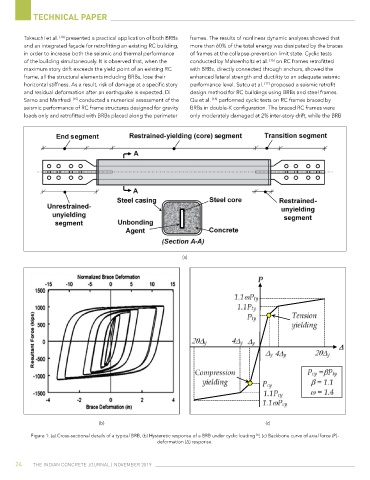
           Figure 1: (a) Cross-sectional details of a typical BRB, (b) Hysteretic response of a BRB under cyclic loading  , (c) Backbone curve of axial force (P)-
                                                     deformation (∆) response.


      24    The IndIan ConCreTe Journal | november 2019

