


Page 3 - Open Access - November
P. 3
TECHNICAL PAPER


         cores  sustained the large plastic strain. Qu et al.   conducted   Design yield axial forces of BRBs in tension (P ty) and compression
                                                [19]
         a numerical investigation on the use of a zigzag BRB in RC   (P cy) can be determined from the material yield stress (ơ yBRB) and
         buildings and concluded that the BRBs are efficient in reducing   core cross-section area (A BRB) as follows:
         the responses of the building, even if the nonlinearity of brace   T=P ty=ϕσ yBRB A BRB                  (2)
         connections is considered. Furthermore, strength demands for
                                                                C=P cy=ϕβσ yBRB A BRB                             (3)
         the brace connections are significantly influenced by the higher
         modes of the system after brace yielding. Qu et al.   studied
                                                  [20]
         the effectiveness of double K-braced RC frame with BRBs under
         cyclic loading.

         The review of literature concluded that BRBs have a good
         potential to be used as strengthening elements in the RC
         frames. These braces can be fitted at the open ground stories to
         improve the lateral strength and displacement ductility and to
         contribute to the energy dissipation capacity of the RC frames.
         However, a design procedure to determine the required sizes
         of BRBs to carry the desired lateral load is not available in the
         context of seismic strengthening of RC frames. In addition, it
         is necessary to evaluate the effective of BRBs in controlling the
         seismic response of low-to-high rise RC frames.


         2.  ScoPE And oBJEctIVES
         The main objectives of this study are (i) to develop a design                   (a)
         framework for determining the required sizes of BRBs as the
         strengthening elements in a soft-story RC frame, and (ii) to
         evaluate the seismic performance of the strengthened low-
         to-high rise RC frames under earthquake simulated loading
         conditions. BRBs are designed based on the expected
         seismic demand on the OGS buildings frames depending on
         their seismic weights. Thus, force-based design method has
         been adopted in this study to find required sizes of BRBs for
         different frames. Both nonlinear static and dynamic analyses are
         conducted to evaluate the seismic response of strengthened
         frames.


         3. dESIGn oF StrEnGtHEnEd FrAMES
         It is proposed to install BRBs in all bays of the OGS frames. It is
         assumed that the seismic weight of the frames will not change
         significantly due to the installation of BRBs only in the open                  (b)
         ground stories of the study frames. The design procedure
         adopted in this study has been discussed in the following   Figure 2: (a) BRBs located at ground story level of a frame,
         sections:                                                   (b) Axial forces in BRBs under the action of lateral loading.
                                                                Strength reduction factor, Ø , can be taken as 0.9. The
         3.1 determination of BrB Sizes                         compression strength of BRB at any displacement cycle is higher

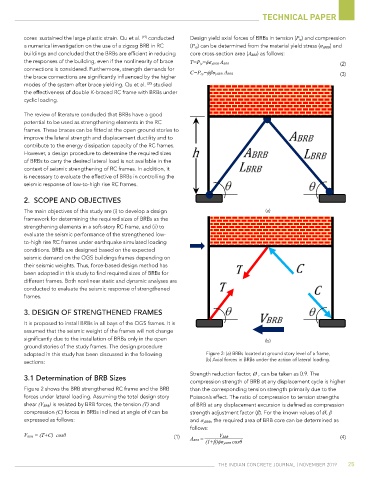
         Figure 2 shows the BRB strengthened RC frame and the BRB   than the corresponding tension strength primarily due to the
         forces under lateral loading. Assuming the total design story   Poisson’s effect. The ratio of compression to tension strengths
         shear (V BRB) is resisted by BRB forces, the tension (T) and   of BRB at any displacement excursion is defined as compression
         compression (C) forces in BRBs inclined at angle of θ can be   strength adjustment factor (β). For the known values of Ø, β
         expressed as follows:                                  and ơ yBRB, the required area of BRB core can be determined as
                                                                follows:
         V BRB = (T+C)  cosθ                               (1)            V BRB                                   (4)
                                                                A BRB =
                                                                     (1+β)ϕσ yBRB cosθ


                                                                         The IndIan ConCreTe Journal | november 2019  25

