


Page 3 - Circular Economy - Andrew J. Minson
P. 3
point of view


         Secondly and more briefly, building design strategy. Two   will initially be focussed on ensuring procedures are in place
         competing approaches to building design in response to circular   to process returned concrete and to encourage maximum
         economy are demountable structures or long-life loose-fit   recovery of this returned concrete thereby minimising waste
         structures. The first is self-explanatory. The second is about   to disposal. The data collection of use in concrete of recycled
         both engineering the structure for longevity and designing for   aggregates and recycled concrete aggregates has not been
         architectural flexibility (loose-fit) so that future modifications,   a priority because of the reasons given above. The use of
         refurbishments and even re-purposing can be done with   secondary cementitious at the ready-mixed plant is another
         minimum of work to ensure the asset does not become    circular economy opportunity, but once again is a lower priority
         obsolete. The first maximises closed loop; the latter slows the   for data collection, because it is not fully in the control of the
         loop. Which is most appropriate depends on a project. Both   ready-mixed concrete producer: addition can be at the cement
         require some anticipation of what the future holds, and it is this   plant and overall replacement level is contingent on client
         anticipation, or assumption about the future, that makes a whole   specification.
         life cycle assessment comparison between the options difficult
         and perhaps even subjective. I would contend that housing,   GCCA has become a member and is a keen supporter of the
         education and medical facilities are typically known needs   Concrete Sustainability Council (CSC) - a not for profit that
         that will last for many decades and into the next century and a   administers the only global responsible sourcing scheme for
         long-life loose-fit will enable most efficient use of resources. As   concrete. Given that society is demanding material supply in
         a structural engineer I can design this more resource efficiently   excess of that available from recycling, responsible sourcing of
         than a demountable structure. But for a project which is only   those virgin materials needs to be in place. CSC has a supplier
         needed for a short period, a less structurally efficient design may   certification scheme that covers virgin aggregates. In July
         be the answer in order that whole elements – columns, beams   2019 CSC added a route for supplier certification for recycled
         and floor units - can be dismantled, transported and erected   aggregates (Concrete Sustainability Council-2019).
         elsewhere. All the impacts must be considered on a project by
         project basis to determine the optimum solution.       In terms of our global communications and advocacy, GCCA
                                                                communicates the sustainable credentials of concrete and why it
         4. gcca cIrcular EconoMy actIvIty                      should be the material of choice. When appropriate we use the
                                                                lens of circular economy to do this. We communicate what our
         The GCCA has a spectrum of activity that can be described   industry is doing in terms of circularity in production and how
         under the umbrella of circular economy: relating to both   concrete can be designed and used to contribute to a circular
         production and how concrete is used. GCCA has been passed   economy. For example, I did this at the World Built Environment
         responsibility for the global annual data collection for the   Forum in New York in May 2019.
         cement industry previously administered by the Cement
         Sustainability Initiative under the World Business Council for
         Sustainable Development. The GNR data (“gCCA in numbers”)
         is a key tool in how key sustainability progress is monitored and
         reported. With respect to circular economy, key data reported is
         clinker to cement ratio (i.e use of secondary cementitious) and
         the use of biomass and alternative fuels, such as municipal and
         industrial refuse. These refuse materials have been diverted from
         landfill and incineration and are co-processed during cement
         manufacturing. Use of biomass and alternative fuels reduces
         consumption of fossil fuels and has seen an eight-fold increase
         between 1990 and 2017 (GCCA-2019).
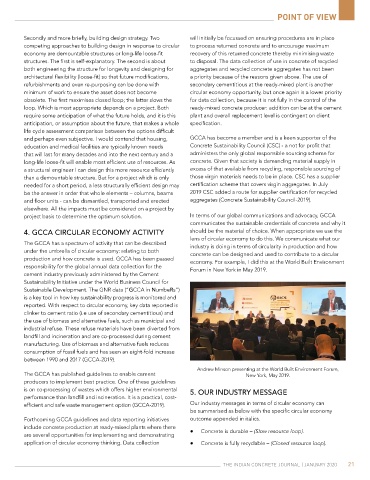
                                                                  Andrew Minson presenting at the World Built Environment Forum,
         The GCCA has published guidelines to enable cement                       New York, May 2019.
         producers to implement best practice. One of these guidelines
         is on co-processing of wastes which offers higher environmental   5. our Industry MEssagE
         performance than landfill and incineration. It is a practical, cost-
         efficient and safe waste management option (GCCA-2019).  Our industry messages in terms of circular economy can
                                                                be summarised as below with the specific circular economy
         Forthcoming GCCA guidelines and data reporting initiatives   outcome appended in italics.
         include concrete production at ready-mixed plants where there
         are several opportunities for implementing and demonstrating   •   Concrete is durable – (Slow resource loop).
         application of circular economy thinking. Data collection   •   Concrete is fully recyclable – (Closed resource loop).


                                                                           The IndIan ConCreTe Journal | JanuarY 2020  21

