


Page 4 - Circular Economy - Andrew J. Minson
P. 4
point of view


         •   Concrete uses secondary aggregates from other industries   Going further, it is useful to also communicate:
             – (Closing resource loops for other industries).
                                                                •   Society’s demand for building materials outstrips what is
         •   Cement/Concrete uses by products from other industries to   available from demolition, so virgin materials are needed.
             replace cement clinker – (Closing resource loops for other   For these virgin materials responsible sourcing should be
             industries).                                           specified.
         •   Clinker manufacture uses waste as fuel and raw material (co-  •   The demolition industry should be encouraged to maximise
             processing) – (Closing resource loops for other industries).  recovery of hard demolition waste.
         •   Concrete can enable optimised design solutions because it   •   The system boundary for recycled concrete aggregates
             is versatile (in constituents, production, how/where it is cast,   should be the whole aggregates industry and not the
             design, finish and texture) – (Narrowing resource loop).  subset of concrete, to avoid perverse outcome of virgin
         •   Concrete can be used for design for disassembly (DfD) –   aggregates begin transported from A to B and recycled
             (Closed resource loop).                                concrete aggregates from B to A.

                                                                6. conclusIon
          Country example: UK and Recycled/Secondary Aggregates
                                                                Circular economy is a term widely used and encompasses many
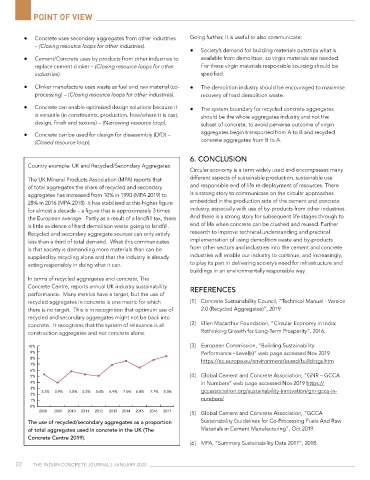
          The UK Mineral Products Association (MPA) reports that   different aspects of sustainable production, sustainable use
          of total aggregates the share of recycled and secondary   and responsible end of life re-deployment of resources. There
          aggregates has increased from 10% in 1990 (MPA 2019) to   is a strong story to communicate on the circular approaches
          28% in 2016 (MPA 2018). It has stabilised at this higher figure   embedded in the production side of the cement and concrete
          for almost a decade – a figure that is approximately 3 times   industry, especially with use of by-products from other industries.
          the European average.  Partly as a result of a landfill tax, there   And there is a strong story for subsequent life stages through to
          is little evidence of hard demolition waste going to landfill.    end of life when concrete can be crushed and reused. Further
          Recycled and secondary aggregate sources can only satisfy   research to improve technical understanding and practical
          less than a third of total demand.  What this communicates   implementation of using demolition waste and by-products
          is that society is demanding more materials than can be   from other sectors and industries into the cement and concrete
          supplied by recycling alone and that the industry is already   industries will enable our industry to continue, and increasingly,
          acting responsibly in doing what it can.              to play its part in delivering society’s need for infrastructure and
                                                                buildings in an environmentally responsible way.
          In terms of recycled aggregates and concrete, The
          Concrete Centre, reports annual UK industry sustainability   rEfErEncEs
          performance.  Many metrics have a target, but the use of
          recycled aggregates in concrete is one metric for which   [1]  Concrete Sustainability Council, “Technical Manual - Version
          there is no target.  This is in recognition that optimum use of   2.0 (Recycled Aggregates)”, 2019.
          recycled and secondary aggregates might not be back into
          concrete.  It recognises that the system of relevance is all   [2]  Ellen Macarthur Foundation, “Circular Economy in India:
          construction aggregates and not concrete alone.           Rethinking Growth for Long-Term Prosperity”, 2016.

                                                                [3]  European Commission, “Building Sustainability
                                                                    Performance - Level(s)” web page accessed Nov 2019

                                                                    https://ec.europa.eu/environment/eussd/buildings.htm


                                                                [4]  Global Cement and Concrete Association, “GNR – GCCA
                                                                    in Numbers” web page accessed Nov 2019 https://

                                                                                    gccassociation.org/sustainability-innovation/gnr-gcca-in-

                                                                    numbers/


                                                                [5]  Global Cement and Concrete Association, “GCCA
          the use of recycled/secondary aggregates as a proportion   Sustainability Guidelines for Co-Processing Fuels And Raw
          of total aggregates used in concrete in the uK (the       Materials in Cement Manufacturing”, Oct 2019.
          concrete centre 2019).
                                                                [6]  MPA, “Summary Sustainability Data 2017”, 2018.


      22    The IndIan ConCreTe Journal | JanuarY 2020

