


Page 5 - Open-Access-Jan-2020
P. 5
point of view


         The current assertion of circularity in our economy as part of   At the world level, aggregates for concrete in buildings and
         the sustainability of our society has underlined the necessity of   infrastructures, asphalt and subbase materials in road and civil
         a better efficiency of our uses of non-renewable resources such   engineering represent most of the estimated 40-50 billion metric
         as the construction materials as well as a better management of   tonnes extracted from quarries, pits, rivers, coastlines and the
         CDW, which seem to be easily recyclable.               marine environment each year . At the European level, the
                                                                                        6
                                                                demand for aggregates is just over 5 tonnes per capita per year,
         However, CDW recycling is unevenly spread in the construction   i.e. 2.7 billion metric tonnes per year .
                                                                                             7
         sector both worldwide and at the European level where some
         EU countries have been already well advanced for long whereas
         some others are lagging behind the regulatory objective of 70%   For decades, aggregates for construction have been the
         of CDW being recovered by 2020 as prescribed by the European   intermediate industrial product with the lowest value – less than
         Waste Framework Directive 2008/98/EC .                 1 Eurocent per Kg – and, the ways they have been generated
                                        1
                                                                through local extraction sites and basic crushing and screening
         The way to CDW recycling is well paved of remarkable technical   plants were of poor political interest.
         developments but in fact, the sector has still too often been
         facing with regulatory or economic obstacles and prescribers or   After 1945, with the building and infrastructure boom, the
         users’ reluctance.
                                                                demand for aggregates increased and they have been the
         To cope with these challenges, the European Commission has   source of bigger environmental aspects. Therefore, both local
         developed since 2012 several policy initiatives in order to speed   and national authorities have developed more or less stringent
         up the adoption of the best practices in the construction sector   framework to rule this industry. More recently, worries have
         with regard to waste recovery and stimulate its transformation   arisen about the unsustainable way of massive extraction and
         towards more sustainability and competitiveness 2,3,4 .  consumption of these non-renewable natural resources all over
                                                                the world .
                                                                       8
         Beyond these policy initiatives, which could be probably useful
         in any other part of the world wishing to better regulate CDW
         management and recovery, it appears from practitioners’
         experience that some factors are key in order to level down
         barriers to technical sound, environmental friendly, well
         accepted and economically viable CDW recycling.

         At last, more resource efficient uses of construction materials
         and highest rates in recovery of CDW through adequate circular
         design for buildings and infrastructures should be a powerful
         contribution from the construction sector towards a European
         climate neutral economy by 2050 .
                                   5

         2. CoNstRUCtIoN & DeMoLItIoN, the
         FIRst AND gRowINg stReAMs oF RAw
         MAteRIALs CoNsUMeD AND wAste
         geNeRAteD IN the eURoPeAN UNIoN (eU)
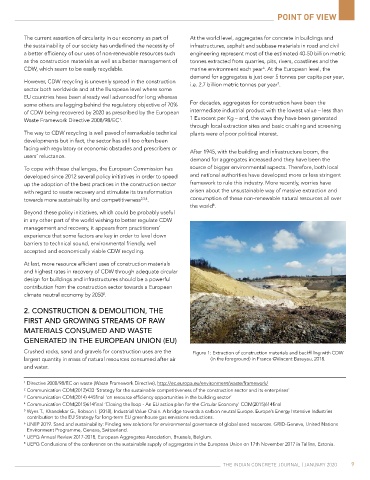
         Crushed rocks, sand and gravels for construction uses are the   Figure 1: Extraction of construction materials and backfilling with CDW
         largest quantity in mass of natural resources consumed after air   (in the foreground) in France ©Vincent Basuyau, 2018.
         and water.

         1   Directive 2008/98/EC on waste (Waste Framework Directive), http://ec.europa.eu/environment/waste/framework/
         2   Communication COM(2012)433 ‘Strategy for the sustainable competitiveness of the construction sector and its enterprises’
         3   Communication COM(2014) 445final ‘on resource efficiency opportunities in the building sector’
         4   Communication COM(2015)614final ‘Closing the loop - An EU action plan for the Circular Economy’ COM(2015)614final
         5   Wyns T., Khandekar G., Robson I. (2018), Industrial Value Chain. A bridge towards a carbon neutral Europe. Europe’s Energy Intensive Industries
          contribution to the EU Strategy for long-term EU greenhouse gas emissions reductions.
         6   UNEP 2019. Sand and sustainability: Finding new solutions for environmental governance of global sand resources. GRID-Geneva, United Nations
          Environment Programme, Geneva, Switzerland.
         7   UEPG Annual Review 2017-2018, European Aggregates Association, Brussels, Belgium.
         8   UEPG Conclusions of the conference on the sustainable supply of aggregates in the European Union on 17th November 2017 in Tallinn, Estonia.


                                                                           The IndIan ConCreTe Journal | JanuarY 2020  9

