


Page 6 - ICJ-August-2020
P. 6
editorial


           Dear Readers,
           We are pleased to bring to you our trilogy edition on Construction & Demolition (C&D) waste. This edition includes research and
           practice papers providing a ringside view of developments on this theme across geographies and the possibilities it holds. This
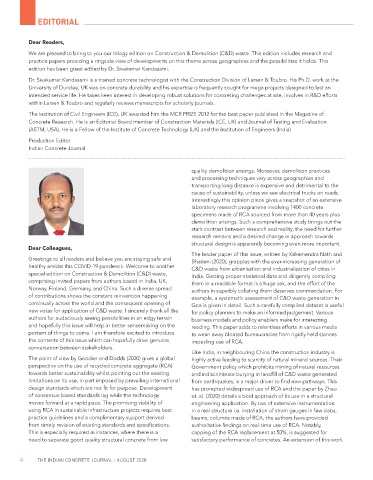
           edition has been guest edited by Dr. Sivakumar Kandasami.
           Dr. Sivakumar Kandasami is a trained concrete technologist with the Construction Division of Larsen & Toubro. His Ph.D. work at the
           University of Dundee, UK was on concrete durability and his expertise is frequently sought for mega projects designed to last an
           intended service life. He takes keen interest in developing robust solutions for concreting challenges at site, involves in R&D efforts
           within Larsen & Toubro and regularly reviews manuscripts for scholarly journals.
           The Institution of Civil Engineers (ICE), UK awarded him the MCR PRIZE 2012 for the best paper published in the Magazine of
           Concrete Research. He is an Editorial Board member of Construction Materials (ICE, UK) and Journal of Testing and Evaluation
           (ASTM, USA). He is a Fellow of the Institute of Concrete Technology (UK) and the Institution of Engineers (India).
           Production Editor
           Indian Concrete Journal


                                                                  quality demolition arisings. Moreover, demolition practices
                                                                  and processing techniques vary across geographies and
                                                                  transporting long distance is expensive and detrimental to the
                                                                  cause of sustainability, unless we see electrical trucks on roads.
                                                                  Interestingly this opinion piece gives a snapshot of an extensive
                                                                  laboratory research programme involving 1400 concrete
                                                                  specimens made of RCA sourced from more than 40 years plus
                                                                  demolition arisings. Such a comprehensive study brings out the
                                                                  stark contrast between research and reality; the need for further
                                                                  research remains and a desired change in approach towards
                                                                  structural design is apparently becoming even more important.
           Dear Colleagues,
                                                                  The leader paper of this issue, written by Kshemendra Nath and
           Greetings to all readers and believe you are staying safe and   Bhatiani (2020), grapples with the ever-increasing generation of
           healthy amidst this COVID-19 pandemic. Welcome to another   C&D waste from urbanisation and industrialisation of cities in
           special edition on Construction & Demolition (C&D) waste,   India. Getting proper statistical data and diligently compiling
           comprising invited papers from authors based in India, UK,   them in a readable format is a huge ask, and the effort of the
           Norway, Finland, Germany, and China. Such a diverse spread   authors in superbly collating them deserves commendation. For
           of contributions shows the constant reinvention happening   example, a systematic assessment of C&D waste generation in
           continually across the world and the consequent opening of   Goa is given in detail. Such a carefully compiled dataset is useful
           new vistas for application of C&D waste. I sincerely thank all the   for policy planners to make an informed judgement. Various
           authors for audaciously seeing possibilities in an edgy terrain   business models and policy enablers make for interesting
           and hopefully this issue will help in better sensemaking on the   reading. This paper adds to relentless efforts in various media
           portent of things to come. I am therefore excited to introduce   to wean away bloated bureaucracies from rigidly held stances
           the contents of this issue which can hopefully drive genuine   impeding use of RCA.
           conversation between stakeholders.
                                                                  Like India, in neighbouring China the construction industry is
           The point of view by Goodier and Dodds (2020) gives a global   highly active leading to scarcity of natural mineral sources. Their
           perspective on the use of recycled concrete aggregate (RCA)   Government policy which prohibits mining of natural resources
           towards better sustainability whilst pointing out the existing   and indiscriminate burying in landfill of C&D waste generated
           limitations on its use, in part imposed by prevailing international   from earthquakes, is a major driver to find new pathways. This
           design standards which are not fit for purpose. Development   has prompted widespread use of RCA and the paper by Zhao
           of consensus-based standards lag while the technology   et. al. (2020) details a bold approach of its use in a structural
           moves forward at a rapid pace. The promising viability of   engineering application. By use of extensive instrumentation
           using RCA in sustainable infrastructure projects requires best   in a real structure i.e. installation of strain gauges in few slabs,
           practice guidelines and a complimentary support derived   beams, columns made of RCA, the authors have provided
           from timely revision of existing standards and specifications.   authoritative findings on real-time use of RCA. Notably,
           This is especially required in instances, where there is a   capping of the RCA replacement at 50%, is suggested for
           need to separate good quality structural concrete from low   satisfactory performance of concretes. An extension of this work


        4     The IndIan ConCreTe Journal | augusT 2020

