


Page 5 - Open-Access-Jan-2022
P. 5
TECHNICAL PAPER


           drying shrinkage  [14] , chloride transport  [15] , effect on alkali-silica
           reactions  [16] , performance in self-compacting concrete  [17] , the
           fresh state performance  [18]  and general durability properties  [19] .
           The main difference between RCA and natural aggregates is
           the adhered mortar on the RCA particles. Compared to natural
           aggregates, this leads to increased porosity and therefore
           higher water absorption (WA), lower bulk and particle density,
           irregular geometry and weaker interfacial transition zone. It was
           reported that the water absorbed to fine RCA during concrete
           mixing was 49 to 89% of the full WA capacity  [11] . Although the
           water transport mechanisms (from cement paste to RCA) are
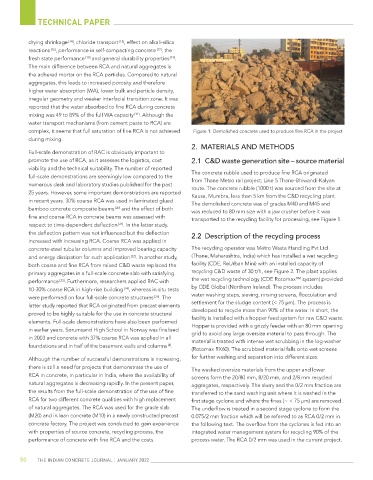
           complex, it seems that full saturation of fine RCA is not achieved   Figure 1: Demolished concrete used to produce fine RCA in the project
           during mixing.
                                                                  2.  MATERIALS AND METHODS
           Full-scale demonstration of RAC is obviously important to
           promote the use of RCA, as it assesses the logistics, cost   2.1  C&D waste generation site – source material
           viability and the technical suitability. The number of reported   The concrete rubble used to produce fine RCA originated
           full-scale demonstrations are seemingly low compared to the   from Thane Metro rail project; Line 5 Thane-Bhiwandi-Kalyan
           numerous desk and laboratory studies published for the past   route. The concrete rubble (1000 t) was sourced from the site at
           25 years. However, some important demonstrations are reported
                                                                  Kausa, Mumbra, less than 5 km from the C&D recycling plant.
           in recent years. 30% coarse RCA was used in laminated glued   The demolished concrete was of grades M40 and M45 and
           bamboo concrete composite beams  [20]  and the effect of both   was reduced to 80 mm size with a jaw crusher before it was
           fine and coarse RCA in concrete beams was assessed with   transported to the recycling facility for processing, see Figure 1.
           respect to time-dependent deflection  [21] . In the latter study,
           the deflection pattern was not influenced but the deflection
                                                                  2.2  Description of the recycling process
           increased with increasing RCA. Coarse RCA was applied in
           concrete-steel tubular columns and improved bearing capacity   The recycling operator was Metro Waste Handling Pvt Ltd
           and energy dissipation for such application  [22] . In another study,   (Thane, Maharashtra, India) which has installed a wet recycling
           both coarse and fine RCA from mixed C&D waste replaced the   facility (CDE, ReUrban Mini) with an installed capacity of
           primary aggregates in a full-scale concrete slab with satisfying   recycling C&D waste of 30 t/h, see Figure 2. The plant applies
           performance  [23] . Furthermore, researchers applied RAC with   the wet recycling technology (CDE Rotomax™ system) provided
           10-30% coarse RCA in high-rise building  [24] , whereas in situ tests   by CDE Global (Northern Ireland). The process includes
           were performed on four full-scale concrete structures  [25] . The   water washing steps, sieving, rinsing screens, flocculation and
           latter study reported that RCA originated from precast elements   settlement for the sludge content (< 75 µm). The process is
           proved to be highly suitable for the use in concrete structural   developed to recycle more than 90% of the water. In short, the
                                                                  facility is installed with a hopper feed system for raw C&D waste.
           elements. Full-scale demonstrations have also been performed   Hopper is provided with a grizzly feeder with an 80 mm opening
           in earlier years. Sørumsand High School in Norway was finalised   grid to avoid any large oversize material to pass through. The
           in 2003 and concrete with 37% coarse RCA was applied in all   material is treated with intense wet scrubbing in the log-washer
           foundations and in half of the basement walls and columns .
                                                          [4]
                                                                  (Rotomax RX60). The scrubbed material falls onto wet screens
           Although the number of successful demonstrations is increasing,   for further washing and separation into different sizes.
           there is still a need for projects that demonstrate the use of
                                                                  The washed oversize materials from the upper and lower
           RCA in concrete, in particular in India, where the availability of   screens form the 20/80 mm, 8/20 mm, and 2/8 mm recycled
           natural aggregates is decreasing rapidly. In the present paper,   aggregates, respectively. The slurry and the 0/2 mm fraction are
           the results from the full-scale demonstration of the use of fine   transferred to the sand washing unit where it is washed in the
           RCA for two different concrete qualities with high replacement   first stage cyclone and where the fines (~ < 75 µm) are removed.
           of natural aggregates. The RCA was used for the grade slab   The underflow is treated in a second stage cyclone to form the
           (M20) and in lean concrete (M10) in a newly constructed precast   0.075/2 mm fraction which will be referred to as RCA 0/2 mm in
           concrete factory. The project was conducted to gain experience   the following text. The overflow from the cyclones is fed into an
           with properties of source concrete, recycling process, the   integrated water management system for recycling 90% of the
           performance of concrete with fine RCA and the costs.   process water. The RCA 0/2 mm was used in the current project.


        50    THE INDIAN CONCRETE JOURNAL | JANUARY 2022

