


Page 5 - openaccess
P. 5
TECHNICAL PAPER


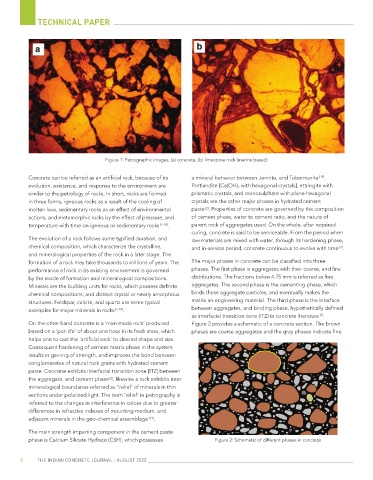
                                     Figure 1: Petrographic images; (a) concrete, (b) limestone rock (marine based)


           Concrete can be referred as an artificial rock, because of its   a mineral behavior between Jennite, and Tobermorite  [12] .
           evolution, existence, and response to the environment are   Portlandite [Ca(OH) 2  with hexagonal crystals], ettringite with
           similar to the petrology of rocks. In short, rocks are formed   prismatic crystals, and monosulphate with plane hexagonal
           in three forms, igneous rocks as a result of the cooling of   crystals are the other major phases in hydrated cement
                                                                       [2]
           molten lava, sedimentary rocks as an effect of environmental   paste . Properties of concrete are governed by the composition
           actions, and metamorphic rocks by the effect of pressure, and   of cement phase, water to cement ratio, and the nature of
           temperature with time on igneous or sedimentary rocks  [7-10] .  parent rock of aggregates used. On the whole, after required
                                                                  curing, concrete is said to be serviceable. From the period when
           The evolution of a rock follows some typified duration, and   raw materials are mixed with water, through its hardening phase,
           chemical composition, which characterize the crystalline,   and in-service period, concrete continuous to evolve with time .
                                                                                                                    [2]
           and mineralogical properties of the rock in a later stage. The
           formation of a rock may take thousands to millions of years. The   The major phases in concrete can be classified into three
           performance of rock in its existing environment is governed   phases. The first phase is aggregates with their coarse, and fine
           by the mode of formation and mineralogical compositions.   distributions. The fractions below 4.75 mm is referred as fine
           Minerals are the building units for rocks, which possess definite   aggregates. The second phase is the cementing phase, which
           chemical compositions, and distinct crystal or nearly amorphous   binds these aggregate particles, and eventually makes the
           structures. Feldspar, calcite, and quartz are some typical   matrix an engineering material. The third phase is the interface
           examples for major minerals in rocks  [7-10] .         between aggregates, and binding phase, hypothetically defined
                                                                  as interfacial transition zone (ITZ) in concrete literature .
                                                                                                              [2]
           On the other hand concrete is a ‘man-made rock’ produced   Figure 2 provides a schematic of a concrete section. The brown
           based on a ‘pot-life’ of about one hour in its fresh state, which   phases are coarse aggregates and the gray phases indicate fine
           helps one to cast the ‘artificial rock’ to desired shape and size.
           Consequent hardening of cement matrix phase in the system
           results in gaining of strength, and improves the bond between
           conglomerates of natural rock grains with hydrated cement
           paste. Concrete exhibits interfacial transition zone [ITZ] between
           the aggregate, and cement phase , likewise a rock exhibits inter
                                       [2]
           mineralogical boundaries referred as “relief’ of minerals in thin
           sections under polarized light. The term ‘relief’ in petrography is
           referred to the changes in interference in colour due to greater
           differences in refractive indexes of mounting medium, and
           adjacent minerals in the geo-chemical assemblage  [11] .
           The main strength imparting component in the cement paste
           phase is Calcium Silicate Hydrate (CSH), which possesses      Figure 2: Schematic of different phases in concrete


        6     THE INDIAN CONCRETE JOURNAL | AUGUST 2022

