


Page 6 - ICJ Jan 2026
P. 6
TECHNICAL PAPER


           properties, high replacement levels of slow-reacting pozzolans   (≡Si-O-Si≡) bridges on the nano-silica surface, generating highly
                                                                                            – [36]
           such as Class F fly ash often delay setting and early strength   reactive silanolate groups (≡Si-O ) . These silanolate sites then
           development [19, 31-33] . This occurs because pozzolanic reactions   undergo hydrolysis to form additional silanol (≡Si-OH) groups
           depend on the availability of CH and proceed more slowly than   while regenerating OH , making the reaction autocatalytic under
                                                                                    –
           the primary hydration of C 3 S and C 2 S, resulting in early-age   high-pH conditions [36-38] . This alkaline depolymerization increases
           behavior dominated mainly by physical filler effects rather than   surface solubility and produces dissolved monomeric silicate
           chemical binding . In contrast, silica fume, due to its extremely   species, enabling rapid participation in hydration chemistry
                        [31]
           high amorphous SiO 2  content and very fine particle size,   rather than behaving as a passive filler.
           provides abundant nucleation sites and exhibits rapid pozzolanic
           reactivity, thereby enhancing early-age strength compared to   These reactions increase the concentration of monomeric
           other SCMs. Despite its extremely high specific surface area,   silicate ions, predominantly represented in cementitious pore
           silica fume does not hydrate independently because it lacks   solutions as H 3 SiO 4 , which immediately participate in early
                                                                                 –
           intrinsic hydraulic reactivity; instead, it reacts only pozzolanically   pozzolanic reaction with calcium hydroxide (CH) ,
                                                                                                        [37]
           by consuming CH released from cement hydration, rather than
                                         [28]
                                                                           2+
                                                                       –
           forming hydration products on its own . These limitations   H 3 SiO 4 + Ca + (1-x) H 2 O → C-S-H x     (10)
           in reactivity and activation windows paved the way for the   (low Ca/Si, highly polymerized)
           development of next-generation nanoscale silica, where the
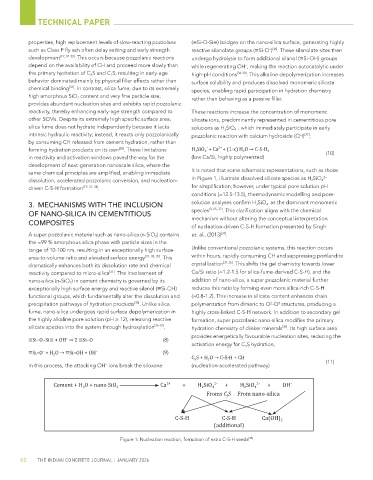
           same chemical principles are amplified, enabling immediate   It is noted that some schematic representations, such as those
                                                                                                               –
           dissolution, accelerated pozzolanic conversion, and nucleation-  in Figure 1, illustrate dissolved silicate species as H 2 SiO 4 ²
           driven C-S-H formation [19, 31, 34] .                  for simplification; however, under typical pore solution pH
                                                                  conditions (≈12.5-13.5), thermodynamic modelling and pore-
                                                                                           –
           3.  MECHANISMS WITH THE INCLUSION                      solution analyses confirm H 3 SiO 4   as the dominant monomeric
                                                                  species [3, 25, 37] . This clarification aligns with the chemical
           OF NANO-SILICA IN CEMENTITIOUS
                                                                  mechanism without altering the conceptual interpretation
           COMPOSITES
                                                                  of nucleation-driven C-S-H formation presented by Singh
           A super pozzolanic material such as nano-silica (n-SiO 2 ) contains   et. al., (2013) .
                                                                            [35]
           the ≈99 % amorphous silica phase with particle sizes in the
           range of 10-100 nm, resulting in an exceptionally high surface-  Unlike conventional pozzolanic systems, this reaction occurs
           area-to-volume ratio and elevated surface energy [31, 33, 35] . This   within hours, rapidly consuming CH and suppressing portlandite
           dramatically enhances both its dissolution rate and chemical   crystallization [31,35] . This shifts the gel chemistry towards lower
                                      [31]
           reactivity compared to micro-silica . The involvement of   Ca/Si ratio (≈1.2-1.5 for silica-fume-derived C-S-H), and the
           nano-silica (n-SiO 2 ) in cement chemistry is governed by its   addition of nano-silica, a super pozzolanic material further
           exceptionally high surface energy and reactive silanol (≡Si-OH)   reduces this ratio by forming even more silica-rich C-S-H
           functional groups, which fundamentally alter the dissolution and   (≈0.8-1.2). This increase in silicate content enhances chain
                                              [36]
           precipitation pathways of hydration products . Unlike silica   polymerization from dimeric to Q²-Q³ structures, producing a
           fume, nano-silica undergoes rapid surface depolymerization in   highly cross-linked C-S-H network. In addition to secondary gel
           the highly alkaline pore solution (pH ≥ 12), releasing reactive   formation, super pozzolanic nano-silica modifies the primary
           silicate species into the system through hydroxylation [36-37] ,  hydration chemistry of clinker minerals . Its high surface area
                                                                                                [39]
                                                                  provides energetically favourable nucleation sites, reducing the
                       –
           ≡Si–O–Si≡ + OH  → 2 ≡Si–O                    (8)
                                                                  activation energy for C 3 S hydration,
               –
           ≡Si–O  + H 2 O → ≡Si–OH + OH –               (9)
                                                                  C 3 S + H 2 O → C-S-H + CH
           In this process, the attacking OH  ions break the siloxane   (nucleation-accelerated pathway)       (11)
                                     –
                                                         2+
                   Cement + H 0 + nano SiO              Ca   +  H SiO    4 2–   +  H SiO 4 2–   +  OH –
                                                                                   2
                                                                     2
                             2
                                        2
                                                                       Froms C S  From nano-silica
                                                                              J
                                                            C-S-H           C-S-H        Ca(OH) 2
                                                                         (additional)

                                          Figure 1: Nucleation reaction, formation of extra C-S-H seeds [35]


        62    THE INDIAN CONCRETE JOURNAL | JANUARY 2026

