


Page 5 - ICJ Feb Openaccess 2026
P. 5
POINT OF VIEW


           Revising the discharge time limit in ASTM C94/C94M  [4]   Historically, a significant volume of ready-mixed concrete–
           encourages a more flexible dialogue between purchasers and   approximately 3 % of total production–has been rejected and
           producers. By tailoring limits to project-specific conditions–  returned to batching plants due to factors such as excessive
           considering mixture type, travel distance, placement method,   slump loss, overproduction, or experimental batches. Strict
           and ambient conditions–both parties can optimize delivery   adherence to the 90-Minute limit has been a primary reason
           without compromising concrete quality. Extended delivery times   for this waste. Revising project specifications and coordinating
           do incur additional costs for materials and truck time; however,   closely with design teams regarding delivery times could reduce
           when these factors are known, steps can be taken to ensure the   concrete rejection rates and enhance sustainability.
           concrete is delivered at the required slump.

           Since the establishment of the 90-Minute requirement in 1935,   5.  EXTENDED DISCHARGE TIME ON THE
           ready-mixed concrete technology has evolved dramatically.   PROPERTIES OF CONCRETE
           Back then, the only remedy for delaying the initial set was to
                                                                                            [9]
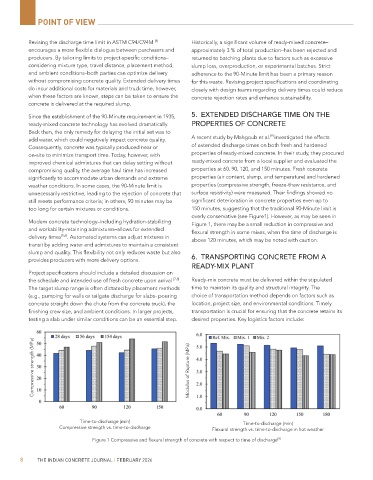
           add water, which could negatively impact concrete quality.   A recent study by Mahgoub et al. investigated the effects
           Consequently, concrete was typically produced near or   of extended discharge times on both fresh and hardened
           on-site to minimize transport time. Today, however, with   properties of ready-mixed concrete. In their study, they procured
           improved chemical admixtures that can delay setting without   ready-mixed concrete from a local supplier and evaluated the
           compromising quality, the average haul time has increased   properties at 60, 90, 120, and 150 minutes. Fresh concrete
           significantly to accommodate urban demands and extreme   properties (air content, slump, and temperature) and hardened
           weather conditions. In some cases, the 90-Minute limit is   properties (compressive strength, freeze-thaw resistance, and
           unnecessarily restrictive, leading to the rejection of concrete that   surface resistivity) were measured. Their findings showed no
           still meets performance criteria; in others, 90 minutes may be   significant deterioration in concrete properties even up to
           too long for certain mixtures or conditions.           150 minutes, suggesting that the traditional 90-Minute limit is
                                                                  overly conservative (see Figure1). However, as may be seen in
           Modern concrete technology–including hydration-stabilizing   Figure 1, there may be a small reduction in compressive and
           and workability-retaining admixtures–allows for extended   flexural strength in some mixes, when the time of discharge is
           delivery times [5,6] . Automated systems can adjust mixtures in   above 120 minutes, which may be noted with caution.
           transit by adding water and admixtures to maintain a consistent
           slump and quality. This flexibility not only reduces waste but also
           provides producers with more delivery options.         6.  TRANSPORTING CONCRETE FROM A
                                                                  READY-MIX PLANT
           Project specifications should include a detailed discussion on
           the schedule and intended use of fresh concrete upon arrival  [7,8] .   Ready-mix concrete must be delivered within the stipulated
           The target slump range is often dictated by placement methods   time to maintain its quality and structural integrity. The
           (e.g., pumping for walls or tailgate discharge for slabs- pouring   choice of transportation method depends on factors such as
           concrete straight down the chute from the concrete truck), the   location, project size, and environmental conditions. Timely
           finishing crew size, and ambient conditions. In larger projects,   transportation is crucial for ensuring that the concrete retains its
           testing a slab under similar conditions can be an essential step.  desired properties. Key logistics factors include:


            Compressive strength (MPa)                           Modulus of Rupture (MPa)


                            Time-to-discharge (min)                                Time-to-discharge (min)
                     Compressive strength vs. time-to-discharge         Flexural strength vs. time-to-discharge in hot weather

                                Figure 1 Compressive and flexural strength of concrete with respect to time of discharge [9]


        8     THE INDIAN CONCRETE JOURNAL | FEBRUARY 2026

