


Page 6 - ICJ Feb Openaccess 2026
P. 6
POINT OF VIEW


           1.   Location and Accessibility: Remote sites may require   Volumetric concrete mixers
               smaller vehicles or specialized trucks to navigate limited
               access.                                            Though relatively new, volumetric mixers are rapidly gaining
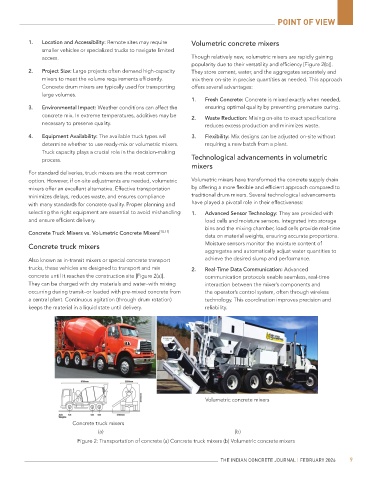
                                                                  popularity due to their versatility and efficiency [Figure 2(b)].
           2.   Project Size: Large projects often demand high-capacity   They store cement, water, and the aggregates separately and
               mixers to meet the volume requirements efficiently.   mix them on-site in precise quantities as needed. This approach
               Concrete drum mixers are typically used for transporting   offers several advantages:
               large volumes.
                                                                  1.   Fresh Concrete: Concrete is mixed exactly when needed,
           3.   Environmental Impact: Weather conditions can affect the   ensuring optimal quality by preventing premature curing.
               concrete mix. In extreme temperatures, additives may be
                                                                  2.   Waste Reduction: Mixing on-site to exact specifications
               necessary to preserve quality.                         reduces excess production and minimizes waste.
           4.   Equipment Availability: The available truck types will   3.   Flexibility: Mix designs can be adjusted on-site without
               determine whether to use ready-mix or volumetric mixers.   requiring a new batch from a plant.
               Truck capacity plays a crucial role in the decision-making
               process.                                           Technological advancements in volumetric
                                                                  mixers
           For standard deliveries, truck mixers are the most common
           option. However, if on-site adjustments are needed, volumetric   Volumetric mixers have transformed the concrete supply chain
           mixers offer an excellent alternative. Effective transportation   by offering a more flexible and efficient approach compared to
           minimizes delays, reduces waste, and ensures compliance   traditional drum mixers. Several technological advancements
           with many standards for concrete quality. Proper planning and   have played a pivotal role in their effectiveness:
           selecting the right equipment are essential to avoid mishandling   1.   Advanced Sensor Technology: They are provided with
           and ensure efficient delivery.                             load cells and moisture sensors. Integrated into storage
                                                                      bins and the mixing chamber, load cells provide real-time
           Concrete Truck Mixers vs. Volumetric Concrete Mixers [10,11]  data on material weights, ensuring accurate proportions.
                                                                      Moisture sensors monitor the moisture content of
           Concrete truck mixers
                                                                      aggregates and automatically adjust water quantities to
           Also known as in-transit mixers or special concrete transport   achieve the desired slump and performance.
           trucks, these vehicles are designed to transport and mix   2.   Real-Time Data Communication: Advanced
           concrete until it reaches the construction site [Figure 2(a)].   communication protocols enable seamless, real-time
           They can be charged with dry materials and water–with mixing   interaction between the mixer’s components and
           occurring during transit–or loaded with pre-mixed concrete from   the operator’s control system, often through wireless
           a central plant. Continuous agitation (through drum rotation)   technology. This coordination improves precision and
           keeps the material in a liquid state until delivery.       reliability.


                                                                      Volumetric concrete mixers


                         Concrete truck mixers
                                  (a)                                           (b)
                           Figure 2: Transportation of concrete (a) Concrete truck mixers (b) Volumetric concrete mixers


                                                                           THE INDIAN CONCRETE JOURNAL | FEBRUARY 2026  9

