


Page 3 - Open Access - Feb 2020
P. 3
TECHNICAL PAPER


                                                                In the presence of fine limestone particles in the hydrating
                                                                cementing matrix, the ettringite precipitated initially is stabilised
                                                                as suggested in  [32] , and the aluminates react with limestone to
                                                                produce carboaluminates as given in Equation 5 and Equation
                                                                6 with varying levels of carbonate ions (i.e., Hemi- or Mono)  [24] .
                                                                Calcined kaolinitic clay catalyses this interaction further due to
                                                                the presence of reactive aluminate. Aluminates in calcined clay
                                                                could also increase the additional demand of gypsum to ensure
                                                                that calcite interaction proceeds after the consumption of
                                                                gypsum, which needs to be controlled to occur after the primary
                                                                silicate reaction  [33] .
                                                        3
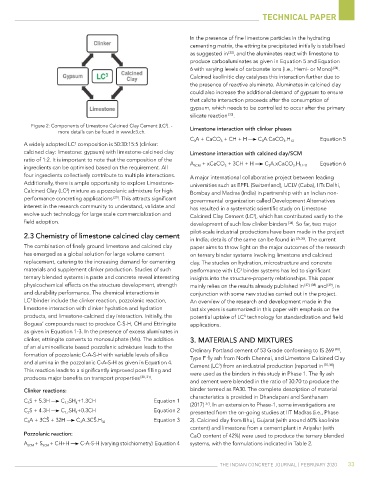
           Figure 2: Components of Limestone Calcined Clay Cement (LC ). -    Limestone interaction with clinker phases
                    more details can be found in www.lc3.ch.
                                                                C 3 A + CaCO 3  + CH + H    C 3 A.CaCO 3 .H 12    Equation 5
         A widely adopted LC  composition is 50:30:15:5 (clinker:
                          3
         calcined clay: limestone: gypsum) with limestone-calcined clay   Limestone interaction with calcined clay/SCM
         ratio of 1:2. It is important to note that the composition of the   A SCM  + xCaCO 3  + 3CH + H    C 3 A.xCaCO 3 .H 12-11    Equation 6
         ingredients can be optimised based on the requirement. All
         four ingredients collectively contribute to multiple interactions.   A major international collaborative project between leading
         Additionally, there is ample opportunity to explore Limestone-  universities such as EPFL (Switzerland), UCLV (Cuba), IITs Delhi,
         Calcined Clay (LC ) mixture as a pozzolanic admixture for high   Bombay and Madras (India) in partnership with an Indian non-
                       2
         performance concreting applications  [29] . This attracts significant   governmental organization called Development Alternatives
         interest in the research community to understand, validate and   has resulted in a systematic scientific study on Limestone
         evolve such technology for large scale commercialization and   Calcined Clay Cement (LC ), which has contributed vastly to the
                                                                                     3
         field adoption.                                        development of such low clinker binders  [34] . So far, two major
                                                                pilot-scale industrial productions have been made in the project
         2.3 Chemistry of limestone calcined clay cement
                                                                in India; details of the same can be found in  [35,36] . The current
         The combination of finely ground limestone and calcined clay   paper aims to throw light on the major outcomes of the research
         has emerged as a global solution for large volume cement   on ternary binder systems involving limestone and calcined
         replacement, catering to the increasing demand for cementing   clay. The studies on hydration, microstructure and concrete
         materials and supplement clinker production. Studies of such   performance with LC  binder systems has led to significant
                                                                                 3
         ternary blended systems in paste and concrete reveal interesting   insights into the structure-property relationships. This paper
         physicochemical effects on the structure development, strength   mainly relies on the results already published in  [37], [38]  and  [39] , in
         and durability performance. The chemical interactions in   conjunction with some new studies carried out in the project.
         LC  binder include the clinker reaction, pozzolanic reaction,   An overview of the research and development made in the
           3
         limestone interaction with clinker hydration and hydration   last six years is summarized in this paper with emphasis on the
         products, and limestone-calcined clay interaction. Initially, the   potential uptake of LC  technology for standardization and field
                                                                                  3
         Bogues’ compounds react to produce C-S-H, CH and Ettringite   applications.
         as given in Equation 1-3. In the presence of excess aluminates in
         clinker, ettringite converts to monosulphate (Ms). The addition   3. MATERIALS AND MIXTURES
         of an aluminosilicate based pozzolanic admixture leads to the   Ordinary Portland cement of 53 Grade conforming to IS 269  [40] ,
         formation of pozzolanic C-A-S-H with variable levels of silica   Type F fly ash from North Chennai, and Limestone Calcined Clay
         and alumina in the pozzolanic C-A-S-H as given in Equation 4.   Cement (LC ) from an industrial production (reported in  [35,36] )
                                                                         3
         This reaction leads to a significantly improved pore filling and   were used as the binders in this study in Phase 1. The fly ash
         produces major benefits on transport properties  [30, 31] .
                                                                and cement were blended in the ratio of 30:70 to produce the
         Clinker reactions:                                     binder termed as FA30. The complete description of material
                                                                characteristics is provided in Dhandapani and Santhanam
         C 3 S + 5.3H    C 1.7 SH 4 +1.3CH          Equation 1
                                                                (2017) . In an extension to Phase-1, some investigations are
                                                                     37]
         C 2 S + 4.3H    C 1.7 SH 4 +0.3CH          Equation 2  presented from the on-going studies at IIT Madras (i.e., Phase
         C 3 A + 3CŜ + 32H    C 3 A.3CŜ.H 32        Equation 3  2). Calcined clay from Bhuj, Gujarat (with around 60% kaolinite
                                                                content) and limestone from a cement plant in Ariyalur (with
         Pozzolanic reaction:                                   CaO content of 42%) were used to produce the ternary blended
         A SCM  + S SCM  + CH+H    C-A-S-H (varying stoichiometry) Equation 4  systems, with the formulations indicated in Table 2.


                                                                          The IndIan ConCreTe Journal | FeBruarY 2020  33

