


Page 6 - Open Access - Feb 2020
P. 6
TECHNICAL PAPER


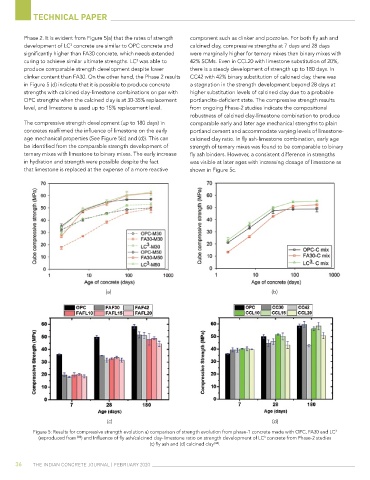
         Phase 2. It is evident from Figure 5(a) that the rates of strength   component such as clinker and pozzolan. For both fly ash and
         development of LC  concrete are similar to OPC concrete and   calcined clay, compressive strengths at 7 days and 28 days
                        3
         significantly higher than FA30 concrete, which needs extended   were marginally higher for ternary mixes than binary mixes with
                                              3
         curing to achieve similar ultimate strengths. LC  was able to   42% SCMs. Even in CCL20 with limestone substitution of 20%,
         produce comparable strength development despite lower   there is a steady development of strength up to 180 days. In
         clinker content than FA30. On the other hand, the Phase 2 results   CC42 with 42% binary substitution of calcined clay, there was
         in Figure 5 (d) indicate that it is possible to produce concrete   a stagnation in the strength development beyond 28 days at
         strengths with calcined clay-limestone combinations on par with   higher substitution levels of calcined clay due to a probable
         OPC strengths when the calcined clay is at 30-35% replacement   portlandite-deficient state. The compressive strength results
         level, and limestone is used up to 15% replacement level.  from ongoing Phase-2 studies indicate the compositional
                                                                robustness of calcined clay-limestone combination to produce
         The compressive strength development (up to 180 days) in   comparable early and later age mechanical strengths to plain
         concretes reaffirmed the influence of limestone on the early   portland cement and accommodate varying levels of limestone-
         age mechanical properties (See Figure 5(c) and (d)). This can   calcined clay ratio. In fly ash-limestone combination, early age
         be identified from the comparable strength development of   strength of ternary mixes was found to be comparable to binary
         ternary mixes with limestone to binary mixes. The early increase   fly ash binders. However, a consistent difference in strengths
         in hydration and strength were possible despite the fact   was visible at later ages with increasing dosage of limestone as
         that limestone is replaced at the expense of a more reactive   shown in Figure 5c.


                                    (a)                                                    (b)


                                    (c)                                                    (d)
            Figure 5: Results for compressive strength evolution a) comparison of strength evolution from phase-1 concrete made with OPC, FA30 and LC 3
                                                                                        3
              (reproduced from  [38] ) and Influence of fly ash/calcined clay-limestone ratio on strength development of LC  concrete from Phase-2 studies
                                                   (c) fly ash and (d) calcined clay  [44] .

      36    The IndIan ConCreTe Journal | FeBruarY 2020

