


Page 100 - ICJ Jan 2023
P. 100
TECHNICAL PAPER                                            COLLECTOR’S EDITION


                              Stone dust was used as procured from the crusher.  RESULTS AND DISCUSSION
                              The fine aggregates used were 100 percent river   The  effect  of  superplasticiser  and partial
                              sand, a mix of 80 percent river sand and 20 percent   replacement of stone  dust on workability,
                              crushed  stone  dust  and  60  percent  river  sand   compressive  strength, modulus of rupture  and
                              and  40  percent  crushed  stone  dust.  The  sieve   splitting  tensile strength are illustrated in  Figs
                              analysis results on random samples for these fine   1 to 4. It is clear from the figures that there is a
                              aggregates are indicated in Table 1.          significant  increase  in  workability,  compressive
                                                                            strength, modulus  of rupture  and split  tensile
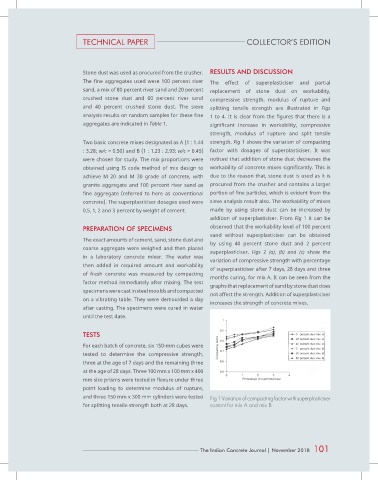
                              Two basic concrete mixes designated as A (1 : 1.44   strength. Fig 1 shows the variation of compacting
                              : 3.28; w/c = 0.50) and B (1 : 1.23 : 2.93; w/c = 0.45)   factor with dosages of superplasticiser. It was
                              were chosen for study. The mix proportions were   noticed that addition of stone dust decreases the
                              obtained  using  IS  code  method  of  mix  design  to   workability of concrete mixes significantly. This is
                              achieve  M  20  and  M  30  grade  of  concrete,  with   due to the reason that, stone dust is used as it is
                              granite  aggregate  and  100  percent  river  sand  as   procured from the crusher and contains a larger
                              fine  aggregate  (referred  to  here  as  conventional   portion of fine particles, which is evident from the
                              concrete). The superplasticiser dosages used were   sieve analysis result also. The workability of mixes
                              0.5, 1, 2 and 3 percent by weight of cement.  made by  using stone  dust can  be increased by
                                                                            addition of superplasticiser. From  Fig  1  it  can  be
                              PREPARATION OF SPECIMENS                      observed that the workability level of 100 percent
                                                                            sand without  superplasticiser  can  be  obtained
                              The exact amounts of cement, sand, stone dust and   by  using  40  percent  stone  dust  and  2  percent
                              coarse aggregate were weighed and then placed   superplasticiser.  Figs  2  (a),  (b) and  (c) show the
                              in  a  laboratory  concrete  mixer.  The water  was   variation of compressive strength with percentage
                              then added in required amount and workability   of superplasticiser after 7 days, 28 days and three
                              of  fresh  concrete  was  measured  by  compacting   months curing, for mix A. It can be seen from the
                              factor method immediately after mixing. The test   graphs that replacement of sand by stone dust does
                              specimens were cast in steel moulds and compacted   not affect the strength. Addition of superplasticiser
                              on a vibrating table. They were demoulded a day   increases the strength of concrete mixes.
                              after casting. The specimens were cured in water
                              until the test date.


                              TESTS

                              For each batch of concrete, six 150-mm cubes were
                              tested  to  determine the compressive  strength,
                              three at the age of 7 days and the remaining three
                              at the age of 28 days. Three 100 mm x 100 mm x 400
                              mm size prisms were tested in flexure under three
                              point loading to determine modulus of rupture,
                              and three 150 mm x 300 mm cylinders were tested   Fig 1 Variation of compacting factor with superplasticiser
                              for splitting tensile strength both at 28 days.  content for mix A and mix B


                                                                        The Indian Concrete Journal | November 2018  101

