


Page 99 - ICJ Jan 2023
P. 99
TECHNICAL PAPER                                            COLLECTOR’S EDITION


                              There has been inadequate utilisation  of large   making effective use of the discarded crushed
                              quantities of crushed stone as alternative material   stone dust in concrete. The test results generated
                              left  out  after  crushing of rock  to  obtain  coarse   through  a well planned  and carefully executed
                              aggregate/ballast for concrete. Crushed stone dust   programme  indicate  good prospects  of  utilising
                              does not satisfy the standard specification of fine   this crushed stone dust as a partial replacement of
                              aggregate in cement mortar and concrete. Efforts   river sand in making quality concrete.
                              have been made to replace river sand by rock dust.
                              Nagaraj et al. have studied the effect of rock dust  EXPERIMENTAL PROGRAMME
                                                                        1
                              and pebble as aggregate in cement and concrete .   Materials
                              They found that crushed stone dust could be used
                              to  replace  the  natural  sand  in  concrete.  Babu   The cement used for the investigation  was 43
                              studied  the  performance  of  quarry  waste  as  fine   grade ordinary portland cement (OPC). The initial
                                                  2
                              aggregate in concrete .  Shukla  et al. investigated   and  final  setting  times  were  45  and  300  minutes
                              the behaviour  of concrete  made by  partial/full   respectively;  the  3-day  and  7-day  compressive
                                                                                                                  2
                                                                                                   2
                              replacement of river sand by crushed stone dust as   strengths were 19.2 N /mm  and 26.04 N/mm
                              fine aggregate and reported that 40 percent sand
                              can be replaced by crushed  stone dust without   Crushed  granite  aggregate  having  nominal  size
                              affecting the strength of concrete .  Pofale  and   of  20  mm  was  used  as  coarse  aggregate.  Sand
                                                             3
                              Kulkarni  investigated  the  behaviour  of  concrete   collected from nearby river was used without any
                              mixes with natural sand partially and fully replaced   refinement. Crushed stone dust procured from a
                              by crushed stone powder (basalt) from aggregate   crusher in Goramachia (Jhansi) was used.
                              crushing plant waste . It is reported that crushed
                                                4
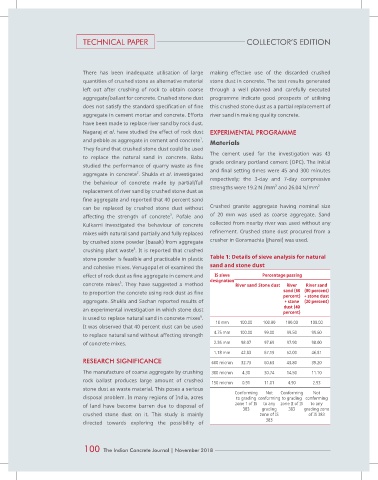
                              stone powder is feasible and practicable in plastic   Table 1: Details of sieve analysis for natural
                              and cohesive mixes. Venugopal et al examined the   sand and stone dust
                              effect of rock dust as fine aggregate in cement and   IS sieve  Percentage passing
                              concrete mixes . They have suggested  a method   designation  River sand Stone dust  River   River sand
                                            5
                                                                                                      sand (60  (80 percent)
                              to proportion the concrete using rock dust as fine                     percent)  + stone dust
                              aggregate. Shukla and Sachan reported results of                        + stone  (20 percent)
                                                                                                      dust (40
                              an experimental investigation in which stone dust                      percent)
                                                                        6
                              is used to replace natural sand in concrete mixes .   10 mm  100.00   100.00   100.00   100.00
                              It was observed that 40 percent dust can be used
                              to replace natural sand without affecting strength   4.75 mm  100.00   99.00   99.50   99.60
                              of concrete mixes.                             2.36 mm   98.07   97.69   97.90    98.00
                                                                             1.18 mm   42.83   67.19   52.00    46.81
                              RESEARCH SIGNIFICANCE                         600 micron   32.73   60.63   43.80   39.20

                              The manufacture of coarse aggregate by crushing   300 micron   4.30   30.74   14.50   11.10
                              rock  ballast  produces large  amount  of crushed   150 micron   0.91   11.01   4.90   2.93
                              stone dust as waste material. This poses a serious
                                                                                    Conforming   Not   Conforming   Not
                              disposal problem. In many regions of India, acres      to grading  conforming to grading  conforming
                              of land have become barren due to  disposal of        zone 1 of IS   to any  zone II of IS   to any
                                                                                       383    grading   383  grading zone
                              crushed stone  dust  on  it.  This  study  is  mainly          zone of IS       of IS 383
                                                                                               383
                              directed towards exploring the possibility  of


                               100 The Indian Concrete Journal | November 2018

