


Page 6 - Open Access-June 2019
P. 6
TECHNICAL PAPER


         Anders (2016) conducted experiments in order to investigate the   3. EXPERIMENTAL WORK
         effects of different types of cements and aggregates, increased
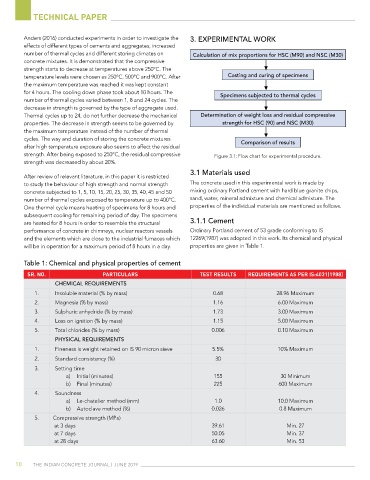
         number of thermal cycles and different storing climates on   Calculation of mix proportions for HSC (M90) and NSC (M30)
         concrete mixtures. It is demonstrated that the compressive
         strength starts to decrease at temperatures above 250°C. The
         temperature levels were chosen as 250°C, 500°C and 900°C. After    Casting and curing of specimens
         the maximum temperature was reached it was kept constant
         for 4 hours. The cooling down phase took about 10 hours. The
                                                                          Specimens subjected to thermal cycles
         number of thermal cycles varied between 1, 8 and 24 cycles. The
         decrease in strength is governed by the type of aggregate used.
         Thermal cycles up to 24, do not further decrease the mechanical   Determination of weight loss and residual compressive
         properties. The decrease in strength seems to be governed by      strength for HSC (90) and NSC (M30)
         the maximum temperature instead of the number of thermal
         cycles. The way and duration of storing the concrete mixtures
         after high temperature exposure also seems to affect the residual       Comparison of results
         strength. After being exposed to 250°C, the residual compressive   Figure 3.1: Flow chart for experimental procedure.
         strength was decreased by about 20%.
                                                                3.1 Materials used
         After review of relevant literature, in this paper it is restricted
         to study the behaviour of high strength and normal strength   The concrete used in this experimental work is made by
         concrete subjected to 1, 5, 10, 15, 20, 25, 30, 35, 40, 45 and 50   mixing ordinary Portland cement with hard blue granite chips,
         number of thermal cycles exposed to temperature up to 400°C.   sand, water, mineral admixture and chemical admixture. The
         One thermal cycle means heating of specimens for 8 hours and   properties of the individual materials are mentioned as follows.
         subsequent cooling for remaining period of day. The specimens
         are heated for 8 hours in order to resemble the structural   3.1.1 Cement
         performance of concrete in chimneys, nuclear reactors vessels   Ordinary Portland cement of 53 grade conforming to IS
         and the elements which are close to the industrial furnaces which   12269(1987) was adopted in this work. Its chemical and physical
         will be in operation for a maximum period of 8 hours in a day.  properties are given in Table 1.


         Table 1: Chemical and physical properties of cement
          sR. nO.                  paRtICuLaRs                     tEst REsuLts    REquIREMEnts as pER Is:4031(1988)
                   CHEMICAL REQUIREMENTS
            1.     Insoluble material (% by mass)                       0.68                 28.96 Maximum
            2.     Magnesia (% by mass)                                 1.16                 6.00 Maximum
            3.     Sulphuric anhydride (% by mass)                      1.73                 3.00 Maximum
            4.     Loss on ignition (% by mass)                         1.15                 5.00 Maximum
            5.     Total chlorides (% by mass)                         0.006                 0.10 Maximum

                   PHYSICAL REQUIREMENTS
            1.     Fineness is weight retained on IS 90 micron sieve   5.5%                  10% Maximum
            2.     Standard consistency (%)                             30
            3.     Setting time
                       a)  Initial (minutes)                            155                   30 Minimum
                       b)  Final (minutes)                              225                  600 Maximum
            4.     Soundness
                       a)  Le-chatelier method (mm)                     1.0                  10.0 Maximum
                       b)  Autoclave method (%)                        0.026                 0.8 Maximum
            5.     Compressive strength (MPa)
                    at 3 days                                          39.61                    Min. 27
                    at 7 days                                          50.05                    Min. 37
                    at 28 days                                         63.60                    Min. 53


      10    The IndIan ConCreTe Journal | June 2019

