


Page 5 - Open-Access-Dec-2019
P. 5
TECHNICAL PAPER


         Damage pattern of cover material and mass loss and mass   2.2 Specimen Preparation
         loss rate of the steel reinforcing bar after different duration of
         corrosion were reported. Residual flexural strength and failure   The solid ingredients including cement, GGBS and sand were
         mode of corroded reinforced ECC and FRC prism specimens   dry-mixed first for 3 min. Water and superplasticizer were then
         were examined.                                         added in the mixture and mixed for another 3 min. PVA fibres
                                                                were then slowly added in the fresh mixture and mixed for 5-8
                                                                min to ensure good fibre dispersion without balling. The fresh
         2. ExPERIMENTAL PRoCEDURE
                                                                mixtures were cast into different molds for the preparation of
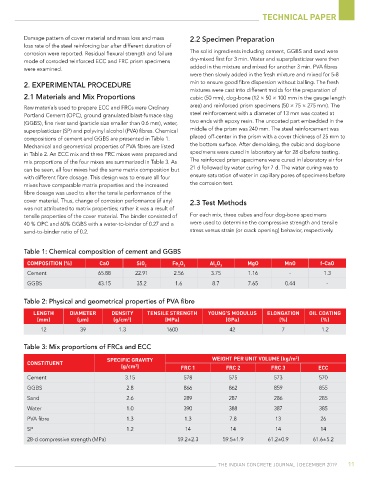
         2.1 Materials and Mix Proportions                      cubic (50 mm), dog-bone (12 × 50 × 100 mm in the gauge length

         Raw materials used to prepare ECC and FRCs were Ordinary   area) and reinforced prism specimens (50 × 75 × 275 mm). The
         Portland Cement (OPC), ground granulated blast-furnace slag   steel reinforcement with a diameter of 13 mm was coated at
         (GGBS), fine river sand (particle size smaller than 0.6 mm), water,   two ends with epoxy resin. The uncoated part embedded in the
         superplasticizer (SP) and polyvinyl alcohol (PVA) fibres. Chemical   middle of the prism was 240 mm. The steel reinforcement was
         compositions of cement and GGBS are presented in Table 1.   placed off-center in the prism with a cover thickness of 25 mm to
         Mechanical and geometrical properties of PVA fibres are listed   the bottom surface. After demolding, the cubic and dog-bone
         in Table 2. An ECC mix and three FRC mixes were prepared and   specimens were cured in laboratory air for 28 d before testing.
         mix proportions of the four mixes are summarized in Table 3. As   The reinforced prism specimens were cured in laboratory air for
         can be seen, all four mixes had the same matrix composition but   21 d followed by water curing for 7 d. The water curing was to
         with different fibre dosage. This design was to ensure all four   ensure saturation of water in capillary pores of specimens before
         mixes have comparable matrix properties and the increased   the corrosion test.
         fibre dosage was used to alter the tensile performance of the
         cover material. Thus, change of corrosion performance (if any)   2.3 Test Methods
         was not attributed to matrix properties; rather it was a result of
         tensile properties of the cover material. The binder consisted of   For each mix, three cubes and four dog-bone specimens
         40 % OPC and 60% GGBS with a water-to-binder of 0.27 and a   were used to determine the compressive strength and tensile
         sand-to-binder ratio of 0.2.                           stress versus strain (or crack opening) behavior, respectively.


         Table 1: Chemical composition of cement and GGBS

          CoMposition (%)         Cao         sio 2       fe 2 o 3    al 2 o 3     Mgo         Mno         f-Cao
          Cement                 65.88        22.91        2.56        3.75        1.16          -          1.3
          GGBS                   43.15        35.2         1.6         8.7         7.65        0.44          -


         Table 2: Physical and geometrical properties of PVA fibre
            Length      DiaMeter      DensitY     tensiLe strength    Young’s MoDuLus    eLongation    oiL Coating
             (mm)          (μm)        (g/cm )          (Mpa)               (gpa)            (%)           (%)
                                           3
               12           39          1.3             1600                 42               7            1.2


         Table 3: Mix proportions of FRCs and ECC
                                                                                                   3
                                    speCifiC gravitY                   Weight per unit voLuMe (kg/m )
          Constituent
                                         (g/cm )             frC 1          frC 2          frC 3          eCC
                                              3
          Cement                          3.15                578            575            573            570
          GGBS                             2.8                866            862            859            855
          Sand                             2.6                289            287            286            285

          Water                            1.0                390            388            387            385
          PVA fibre                        1.3                1.3            7.8            13             26
          SP                               1.2                14             14             14             14
          28-d compressive strength (MPa)                   59.2±2.3       59.5±1.9       61.2±0.9       61.6±5.2


                                                                         The IndIan ConCreTe Journal | deCember 2019  11

