


Page 9 - Open-Access-Dec-2019
P. 9
F
F
F
F
/iÃi ÃÌÀiÃÃ *>®
Óx
F
F
Óä
£x
(4%
£ä
(4%
(4%
'%%
LiÀ `Ã>}i ¯®
F
(4%
F
F
(4%
(4%
F
F
F
(4%
(4%
®
F
>Óx
F
Þ
`
F
'%%
`
F
'%%
i
À
«
i
Óä
«
¯
à >Ãà Ãà ¯®
¯
ä°äÈxÝ
i
Þ r ÓÈ°Îni
Ì
>
i
Ì £x
Ã
,Ô r ä°ÎÎx
À
>
À
Ã
Ã
Ã
(4%
£ä
Ã
>
Ã
(4%
Ã
>
(4%
F
F
'%%
F
F
F
F
/iÃi ÃÌÀiÃà *>® /iÃi ÃÌÀiÃà *>® /iÃi ÃÌÀ> ¯® À VÀ>V «i} ® ® Þ > À /iÃi ÃÌÀ> ¯® À VÀ>V «i} ® F >Ãà Ãà ¯® >Ãà Ãà ¯® , £ , Ó , Î F F ® Þ Ì V > « > V ` > > À Õ Ý i >Ãà Ãà ¯® >Ãà Ãà v ÃÌii ÀivÀViiÌ
Óx
, Ó
, Î
, £
F
F
LiÀ `Ã>}i ¯®
, Î
, Ó
, £
ÕÀ>Ì v >VViiÀ>Ìi` VÀÀà `>Þî
Óä
TECHNICAL PAPER
>Ãà Ãà ¯® >Ãà Ãà ¯® £x
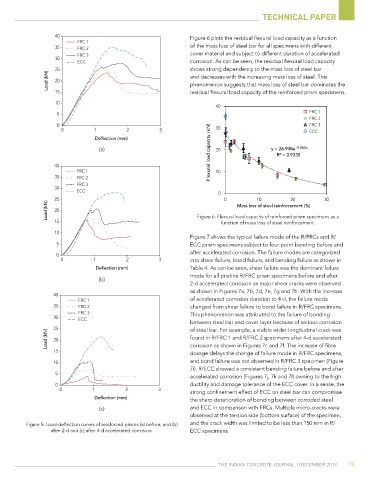
(4% (4% F F Figure 6 plots the residual flexural load capacity as a function
£ä
F
(4% F (4% (4% (4%
(4% (4% F of the mass loss of steel bar for all specimens with different (4%
F
(4%
® Þ > ` (4% (4% F ® Þ > Óx (4% F cover material and subject to different duration of accelerated (4%
/iÃi ÃÌÀiÃà *>® ¯ À i « i Ì > À /iÃi ÃÌÀ> ¯® À VÀ>V «i} ® ` À i « , £ , Ó , Î F corrosion. As can be seen, the residual flexural load capacity >` ® '%%
(4%
(4%
®
F
(4%
(4%
F
'%%
'%%
F
'%%
'%%
'%%
Þ
Ì
>` ® Óä
shows strong dependency to the mass loss of steel bar
>Ãà Ãà ¯®
V
>Ãà Ãà ¯®
>
¯
«
>` ®
and decreases with the increasing mass loss of steel. This
ä°äÈxÝ
Þ r ÓÈ°Îni
LiÀ `Ã>}i ¯®
>
V
i
£x
`
,Ô r ä°ÎÎx
Ì
>
residual flexural load capacity of the reinforced prism specimens.
(4% à à à > À à à £ä phenomenon suggests that mass loss of steel bar dominates the
>
à > à À Õ
(4% Ã > Ý i
(4% (4%
'%% F (4%
® (4% F (4%
Þ > (4% ® ® (4%
` , £ , Ó , Î Þ > F
'%%
/iÃi ÃÌÀ> ¯® À VÀ>V «i} ® À i '%% ÕÀ>Ì v >VViiÀ>Ìi` VÀÀà `>Þî ` , £ , Ó , Î F >Ãà Ãà v ÃÌii ÀivÀViiÌ ¯®
LiÀ `Ã>}i ¯®
« À i Þ Ì
« iviVÌ ® iviVÌ ® iviVÌ ®
¯ V
> «
¯
i (a) > Þ r ÓÈ°Îni ä°äÈxÝ
Ì V
> i
À Ì ` ,Ô r ä°ÎÎx
> >
à à à Ã
(4% Ã >
à > (4% F à (4% (4% À Õ (4%
(4% Ã > (4% Ý i
® (4% F (4% (4%
Þ
> (4% ® (4% F ® (4% (4%
` Þ (4%
>
À ` '%% '%%
i '%% '%% F '%%
« À Þ
i Ì
«
¯
>
¯ «
i > , £ , Ó , Î >Ãà Ãà v ÃÌii ÀivÀViiÌ ¯®
ä°äÈxÝ
Þ r ÓÈ°Îni
Ì ÕÀ>Ì v >VViiÀ>Ìi` VÀÀà `>Þî
> >` ® V >` ® V >` ®
i
À Ì ` ,Ô r ä°ÎÎx
>
à À >
à Figure 6: Flexural load capacity of reinforced prism specimens as a
Ã
Ã
function of mass loss of steel reinforcement.
à >
à > Ã Ã Õ Ý
i Figure 7 shows the typical failure mode of the R/FRCs and R/
>
(4%
(4% (4% ECC prism specimens subject to four-point bending before and
(4% (4% (4%
after accelerated corrosion. The failure modes are categorized
(4%
(4% (4% into shear failure, bond failure, and bending failure as shown in
'%%
ÕÀ>Ì v >VViiÀ>Ìi` VÀÀà `>Þî '%% , £ , Ó , Î '%% >Ãà Ãà v ÃÌii ÀivÀViiÌ ¯®
iviVÌ ®
iviVÌ ® iviVÌ ® Table 4. As can be seen, shear failure was the dominant failure
>` ®
>` ® >` ® (b) 2-d accelerated corrosion as major shear cracks were observed
mode for all pristine R/FRC prism specimens before and after
as shown in Figures 7a, 7b, 7d, 7e, 7g and 7h. With the increase
(4% (4% (4% of accelerated corrosion duration to 4 d, the failure mode
(4% (4% (4% changed from shear failure to bond failure in R/FRC specimens.
(4% (4% (4% This phenomenon was attributed to the failure of bonding
'%%
'%% '%% between steel bar and cover layer because of serious corrosion
of steel bar. For example, a visible wider longitudinal crack was
>` ® >` ® iviVÌ ® >` ® iviVÌ ® found in R/FRC 1 and R/FRC 2 specimens after 4-d accelerated
iviVÌ ®
corrosion as shown in Figures 7c and 7f. The increase of fibre
dosage delays the change of failure mode in R/FRC specimens,
and bond failure was not observed in R/FRC 3 specimen (Figure
7i). R/ECC showed a consistent bending failure before and after
accelerated corrosion (Figures 7j, 7k and 7l) owning to the high
ductility and damage tolerance of the ECC cover. In a sense, the
strong confinement effect of ECC on steel bar can compromise
iviVÌ ® iviVÌ ® iviVÌ ® the sharp deterioration of bonding between corroded steel
(c) and ECC in comparison with FRCs. Multiple micro-cracks were
observed at the tension side (bottom surface) of the specimen,
Figure 5: Load-deflection curves of reinforced prisms (a) before, and (b) and the crack width was limited to be less than 150 mm in R/
after 2-d and (c) after 4-d accelerated corrosion. ECC specimens.
The IndIan ConCreTe Journal | deCember 2019 15

