


Page 2 - Open Access - Feb 2020
P. 2
TECHNICAL PAPER


         for cement substitutes. This increase in demand can be   Table 1: Summary of the emission factor of different
         leveraged by combined substitution of SCMs, which are likely   binding materials
         to accommodate a wide range of SCMs with various levels
         of quality and reactivity potential. The cement sustainability   oPtions for Binding   emission factor    sources
         initiative (CSI) predicts that the contribution of limestone   materials       (kg-co 2  Per kg-
         would increase from 8% in 2014 to nearly 18% by 2050                             material)
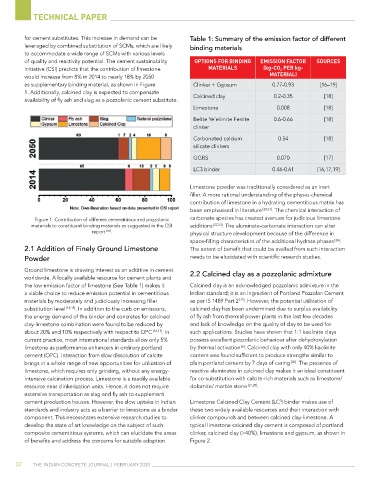
         as supplementary binding material, as shown in Figure   Clinker + Gypsum          0.77-0.93       [16–19]
         1. Additionally, calcined clay is expected to compensate   Calcined clay           0.2-0.35        [18]
         availability of fly ash and slag as a pozzolanic cement substitute.
                                                                 Limestone                   0.008          [18]
                                                                 Belite Ye’elimite Ferrite   0.6-0.66       [18]
                                                                 clinker
                                                                 Carbonated calcium          0.54           [18]
                                                                 silicate clinkers
                                                                 GGBS                        0.070          [17]
                                                                 LC3 binder                0.46-0.61      [16,17,19]


                                                                Limestone powder was traditionally considered as an inert
                                                                filler. A more rational understanding of the physio-chemical
                                                                contribution of limestone in a hydrating cementitious matrix has
                                                                been emphasised in literature  [20,21] . The chemical interaction of
            Figure 1: Contribution of different cementitious and pozzolanic   carbonate species has created avenues for judicious limestone
           materials to constituent binding materials as suggested in the CSI   additions  [22,23] . The aluminate-carbonate interaction can alter
                               report  [14] .                   physical structure development because of the difference in
                                                                space-filling characteristics of the additional hydrate phases  [24] .
         2.1 Addition of Finely Ground Limestone                The extent of benefit that could be availed from such interaction
         Powder                                                 needs to be elucidated with scientific research studies.
         Ground limestone is drawing interest as an additive in cement
         worldwide. A locally available resource for cement plants and   2.2 Calcined clay as a pozzolanic admixture
         the low emission factor of limestone (See Table 1) makes it   Calcined clay is an acknowledged pozzolanic admixture in the
         a viable choice to reduce emission potential in cementitious   Indian standard; it is an ingredient of Portland Pozzolan Cement
         materials by moderately and judiciously increasing filler   as per IS 1489 Part 2  [25] . However, the potential utilization of
         substitution level  [14,15] . In addition to the curb on emissions,   calcined clay has been undermined due to surplus availability
         the energy demand of the binder and concretes for calcined   of fly ash from thermal power plants in the last few decades
         clay-limestone combination were found to be reduced by   and lack of knowledge on the quality of clay to be used for
         about 20% and 10% respectively with respect to OPC  [16,17] . In   such applications. Studies have shown that 1:1 kaolinite clays
         current practice, most international standards allow only 5%   possess excellent pozzolanic behaviour after dehydroxylation
                                                                                  [6]
         limestone as performance enhancers in ordinary portland   by thermal activation . Calcined clay with only 40% kaolinite
         cement (OPC). Interaction from slow dissolution of calcite   content was found sufficient to produce strengths similar to
         brings in a whole range of new opportunities for utilization of   plain portland cement by 7 days of curing  [26] . The presence of
         limestone, which requires only grinding, without any energy-  reactive aluminates in calcined clay makes it an ideal constituent
         intensive calcination process. Limestone is a readily available   for co-substitution with calcite-rich materials such as limestone/
         resource near clinkerization units. Hence, it does not require   dolomite/ marble stone  [27,28] .
         extensive transportation as slag and fly ash to supplement
         cement production houses. However, the slow uptake in Indian   Limestone Calcined Clay Cement (LC ) binder makes use of
                                                                                              3
         standards and industry acts as a barrier to limestone as a binder   these two widely available resources and their interaction with
         component. This necessitates extensive research studies to   clinker compounds and between calcined clay-limestone. A
         develop the state of art knowledge on the subject of such   typical limestone calcined clay cement is composed of portland
         composite cementitious systems, which can elucidate the areas   clinker, calcined clay (>40%), limestone and gypsum, as shown in
         of benefits and address the concerns for suitable adoption.  Figure 2.


      32    The IndIan ConCreTe Journal | FeBruarY 2020

