


Page 5 - Open Access - Feb 2020
P. 5
TECHNICAL PAPER


                                    (a)                                                    (b)


                                    (c)                                                    (d)

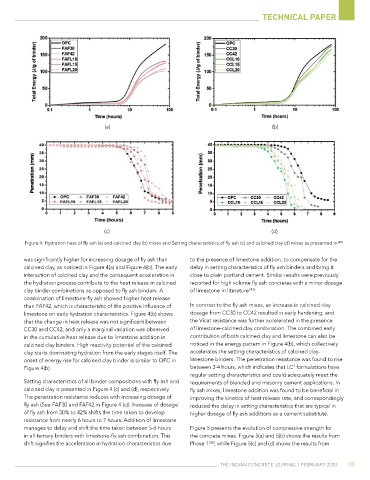
         Figure 4: Hydration heat of fly ash (a) and calcined clay (b) mixes and Setting characteristics of fly ash (c) and calcined clay (d) mixes as presented in  [42] .

         was significantly higher for increasing dosage of fly ash than   to the presence of limestone addition, to compensate for the
         calcined clay, as noticed in Figure 4(a) and Figure 4(b). The early   delay in setting characteristics of fly ash binders and bring it
         interaction of calcined clay and the consequent acceleration in   close to plain portland cement. Similar results were previously
         the hydration process contribute to the heat release in calcined   reported for high volume fly ash concretes with a minor dosage
         clay binder combinations as opposed to fly ash binders. A   of limestone in literature  [43] .
         combination of limestone-fly ash showed higher heat release
         than FAF42, which is characteristic of the positive influence of   In contrast to the fly ash mixes, an increase in calcined clay
         limestone on early hydration characteristics. Figure 4(b) shows   dosage from CC30 to CC42 resulted in early hardening, and
         that the change in heat release was not significant between   the Vicat resistance was further accelerated in the presence
         CC30 and CC42, and only a marginal variation was observed   of limestone-calcined clay combination. The combined early
         in the cumulative heat release due to limestone addition in   contribution of both calcined clay and limestone can also be
         calcined clay binders. High reactivity potential of the calcined   noticed in the energy pattern in Figure 4(b), which collectively
         clay starts dominating hydration from the early stages itself. The   accelerates the setting characteristics of calcined clay-
         onset of energy rise for calcined clay binder is similar to OPC in   limestone binders. The penetration resistance was found to rise
                                                                                                  3
         Figure 4(b).                                           between 3-4 hours, which indicates that LC  formulations have
                                                                regular setting characteristics and could adequately meet the
         Setting characteristics of all binder compositions with fly ash and   requirements of blended and masonry cement applications. In
         calcined clay is presented in Figure 4 (c) and (d), respectively.   fly ash mixes, limestone addition was found to be beneficial in
         The penetration resistance reduces with increasing dosage of   improving the kinetics of heat release rate, and correspondingly
         fly ash (See FAF30 and FAF42 in Figure 4 (c)). Increase of dosage   reduced the delay in setting characteristics that are typical in
         of fly ash from 30% to 42% shifts the time taken to develop   higher dosage of fly ash additions as a cement substitute.
         resistance from nearly 6 hours to 7 hours. Addition of limestone
         manages to delay and shift the time taken between 5-6 hours   Figure 5 presents the evolution of compressive strength for
         in all ternary binders with limestone-fly ash combination. This   the concrete mixes. Figure 5(a) and 5(b) shows the results from
         shift signifies the acceleration in hydration characteristics due   Phase 1  [38] , while Figure 5(c) and (d) shows the results from


                                                                          The IndIan ConCreTe Journal | FeBruarY 2020  35

