


Page 4 - Open Access - Feb 2020
P. 4
TECHNICAL PAPER


         Table 2: Binder systems investigated in the study

                           tyPe           miX id:     oPc (**clinker) %     scm %      limestone* %     gyPsum %
          Phase-1          OPC             OPC               100              -              -              -
                           FA30            FA30              70              30              -              -
                            LC 3            LC 3            50 **            31             15              4
          Phase-2          OPC             OPC               100              -              -              -
                                           FAF30             66              30             3.5            0.5
                                           FAF42            54.5             42              3             0.5
                          Class F         FAFL10            54.5             34             11             0.5
                                          FAFL15            54.5             30             15             0.5
                                          FAFL20            54.5             25             20             0.5
                                           CC30             65.0             30             3.5            1.5
                                           CC42             53.5             42              3             1.5
                        Calcined Clay     CCL10             53.5             34             11             1.5
                                          CCL15             53.5             30             15             1.5
                                          CCL20             53.5             25             20             1.5
         Note: *inclusive of limestone contributed from 5% calcite present in OPC

         Gypsum amount was adjusted for the calcined clay - admixed   A major part of this paper reports the results of three types of
         binder to ensure that the aluminate peak is pushed beyond the   concrete produced with the three binder systems: (i) Concrete
         main silicate hydration peak based on isothermal calorimetry   of grade M30 (i.e. characteristic compressive strength of 30
         profiles. This ensures proper early hydration of tricalcium   MPa), (ii) Concrete of grade M50 (i.e. characteristic compressive
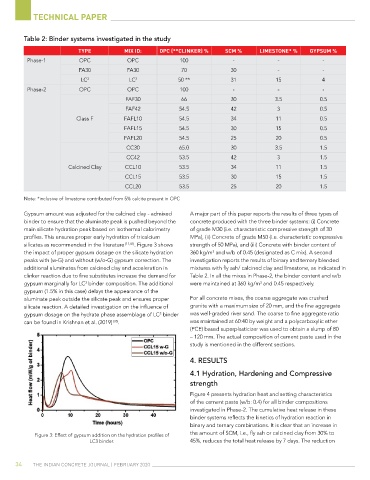
         silicates as recommended in the literature  [11,41] . Figure 3 shows   strength of 50 MPa), and (iii) Concrete with binder content of
         the impact of proper gypsum dosage on the silicate hydration   360 kg/m  and w/b of 0.45 (designated as C mix). A second
                                                                       3
         peaks with (w-G) and without (w/o-G) gypsum correction. The   investigation reports the results of binary and ternary blended
         additional aluminates from calcined clay and acceleration in   mixtures with fly ash/ calcined clay and limestone, as indicated in
         clinker reaction due to fine substitutes increase the demand for   Table 2. In all the mixes in Phase-2, the binder content and w/b
         gypsum marginally for LC  binder composition. The additional   were maintained at 360 kg/m  and 0.45 respectively.
                                                                                       3
                             3
         gypsum (1.5% in this case) delays the appearance of the
         aluminate peak outside the silicate peak and ensures proper   For all concrete mixes, the coarse aggregate was crushed
         silicate reaction. A detailed investigation on the influence of   granite with a maximum size of 20 mm, and the fine aggregate
         gypsum dosage on the hydrate phase assemblage of LC  binder   was well-graded river sand. The coarse to fine aggregate ratio
                                                      3
         can be found in Krishnan et al. (2019)  [33] .         was maintained at 60:40 by weight and a polycarboxylic ether
                                                                (PCE) based superplasticizer was used to obtain a slump of 80
                                                                – 120 mm. The actual composition of cement paste used in the
                                                                study is mentioned in the different sections.


                                                                4. RESULTS
                                                                4.1 Hydration, Hardening and Compressive
                                                                strength

                                                                Figure 4 presents hydration heat and setting characteristics
                                                                of the cement paste (w/b: 0.4) for all binder compositions
                                                                investigated in Phase-2. The cumulative heat release in these
                                                                binder systems reflects the kinetics of hydration reaction in
                                                                binary and ternary combinations. It is clear that an increase in
            Figure 3: Effect of gypsum addition on the hydration profiles of    the amount of SCM, i.e., fly ash or calcined clay from 30% to
                               LC3 binder.                      45%, reduces the total heat release by 7 days. The reduction


      34    The IndIan ConCreTe Journal | FeBruarY 2020

