


Page 4 - Open access sep 2020
P. 4
TECHNICAL PAPER

           CONCRETE


           3D PRINTING –


           PROGRESS WORLDWIDE


           AND IN INDIA                                                                 SHANTANU BHATTACHERJEE,

                                                                                        A. V. RAHUL, MANU SANTHANAM*


           Abstract                                               is cast or printed layer-by-layer through an automated process.
                                                                  One of the major advantages of this printing technique can
           This paper provides a review of the development of digital   be attributed to less or no use of formwork. Binder jetting is
           fabrication methods in the construction industry and academia,   another technology used in 3D printing (Jakupovic, 2016). The
           with a major emphasis on extrusion-based 3D printing. A   construction is done by ejecting/spraying binders like droplets
           detailed description of the work done by the research group in   on the top of a build tray with a carrier material like sand or
           IIT Madras in developing a Portland cement-based 3D printable   cement, as shown in Figure 2.
           formulation is discussed. Finally, the areas in digital fabrication
           that require further research and attention are also highlighted   ETH Zurich developed smart dynamic casting (SDC) (Lloret et
           in this paper.                                         al., 2017); this technique is similar to the slip-forming process
                                                                  but done with a flexible formwork. It employs two different
           Keywords: Digital fabrication, extrusion-based 3D printing, 3D   shaping methods, the first at the exit point, to have minimum
           printable concretes.                                   deformation, and the other one globally, allowing variation
                                                                  in cross-section. The continuous inline measurements and
           1.  INTRODUCTION                                       automated feedback loops are used to control the loading on
                                                                  the concrete already cast at the exit point of the formwork. SDC
           Digital printing of concrete is based on the principle of 3D   uses formwork pressure and friction measurements to define
           printing technology or additive manufacturing. The prevalent   upper and lower strength limits. The technology also allows the
           processes of digital printing are extrusion-based printing, binder   incorporation of reinforcement as the sliding formwork takes
           jetting, mesh mould approach (cutting and welding), smart   care of the pressure exerted outside, i.e. formwork pressure.
           dynamic casting, etc. The additive process in construction with   Using flexible formwork, the variable cross-sectional structures
           automation is suggested by Pegna (1997) and further developed
           by Khoshnevis (2004).                                  can easily be constructed (Lloret et al., 2017). Mesh mould
                                                                  approach for digital printing is developed considering the
           Among all the processes, the most widely used method is the   concept of ferrocement. The approach aims to fabricate the
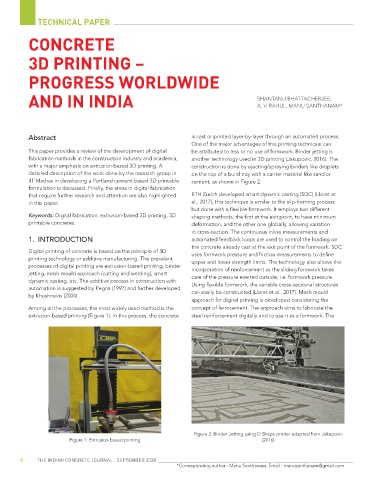
           extrusion-based printing (Figure 1). In this process, the concrete   steel reinforcement digitally and to use it as a formwork. The


                                                                  Figure 2: Binder Jetting using D Shape printer adapted from Jakupovic
                        Figure 1: Extrusion based printing                               (2016)


        8     THE INDIAN CONCRETE JOURNAL | SEPTEMBER 2020
                                                             *Corresponding author : Manu Santhanam, Email : manusanthanam@gmail.com

