


Page 6 - Open access sep 2020
P. 6
TECHNICAL PAPER


           In extrusion-based printing, one of the major challenges is the              Structural
                                                                                      performance
           formation of the bond between the layers. Poor bonds among
           layers can significantly decrease the strength carrying capacity
           of the structure. The presence of such weak interfaces has been
                                                                                                   Reinforcement
           reported to cause anisotropy in the mechanical behaviour of
                                                                          Pumpabiliy
           printed concrete. The lack of models for mechanical parameters   & Buildability
           in 3D printed structures and the absence of structural design                        Mechanical property
           codes require more research and attention.
                                                                       Rheology                Delivery & Placement
           1.2  3D printing for concrete construction                                       Tribology

           In 3D concrete printing, both industry and academia are
                                                                                         VEA
           progressing simultaneously. Concrete printing may provide   SCM
           advantages like rapid repetitive construction in mass housing               Superplasticizer
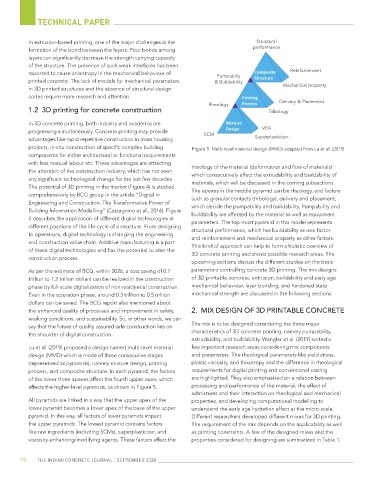
           projects, in-situ construction of specific complex building   Figure 5: Multi-level material design (MMD) adapted from Lu et al. (2019)
           components for either architectural or functional requirements
           with less manual labour etc. These advantages are attracting   rheology of the material (deformation and flow of materials)
           the attention of the construction industry, which has not seen   which consecutively affect the extrudability and buildability of
           any significant technological change for the last few decades.   materials, which will be discussed in the coming subsections.
           The potential of 3D printing in the market (Figure 4) is studied   The apexes in the middle pyramid can be rheology, and factors
           comprehensively by BCG group in the article “Digital in   such as granular contacts (tribology), delivery and placement,
           Engineering and Construction: The Transformative Power of   which decide the pumpability and buildability. Pumpability and
           Building Information Modelling” (Castagnino et al., 2016). Figure   buildability are affected by the material as well as equipment
           4 describes the application of different digital technologies at   parameters. The top-most pyramid in this model represents
           different positions of the life-cycle of a structure. From designing   structural performance, which has buildability as one factor
           to operations, digital technology is changing the engineering   and reinforcement and mechanical property as other factors.
           and construction value chain. Additive manufacturing is a part   This kind of approach can help to form a holistic overview of
           of these digital technologies and has the potential to alter the   3D concrete printing and shows possible research areas. The
           construction process.
                                                                  upcoming sections discuss the different studies on the basic
           As per the estimate of BCG, within 2026, a cost saving of 0.7   parameters controlling concrete 3D printing. The mix designs
           trillion to 1.2 trillion dollars can be realized in the construction   of 3D printable concrete, extrusion, buildability and early age
           phase by full-scale digitalization of non-residential construction.   mechanical behaviour, layer bonding, and hardened state
           Even in the operation phase, around 0.3 trillion to 0.5 trillion   mechanical strength are discussed in the following sections.
           dollars can be saved. The BCG report also mentioned about
           the enhanced quality of processes and improvement in safety,   2.  MIX DESIGN OF 3D PRINTABLE CONCRETE
           working conditions, and sustainability. So, in other words, we can
           say that the future of quality assured safe construction lies on   The mix is to be designed considering the three major
           the shoulder of digital construction.                  characteristics of 3D concrete printing, namely pumpability,
                                                                  extrudability, and buildability. Wangler et al. (2019) sorted a
           Lu et al. (2019) proposed a design named multi-level material   few important research areas considering mix components
           design (MMD) which is made of three consecutive stages   and parameters. The rheological parameters like yield stress,
           (represented as pyramids), namely mixture design, printing   plastic viscosity, and thixotropy and the difference in rheological
           process, and composite structure. In each pyramid, the factors   requirements for digital printing and conventional casting
           of the lower three apexes affect the fourth upper apex, which   are highlighted. They also emphasized on a relation between
           affects the higher-level pyramids, as shown in Figure 5.   processing and performance of the material, the effect of
                                                                  admixtures and their interaction on rheological and mechanical
           All pyramids are linked in a way that the upper apex of the   properties, and developing computational modelling to
           lower pyramid becomes a lower apex of the base of the upper   understand the early age hydration effect at the micro-scale.
           pyramid. In this way, all factors of lower pyramids impact   Different researchers developed different mixes for 3D printing.
           the upper pyramids. The lowest pyramid contains factors   The requirement of the mix depends on the applicability as well
           like raw ingredients (including SCMs), superplasticizer, and   as printing constraints. A few of the designed mixes and the
           viscosity-enhancing/modifying agents. These factors affect the   properties considered for designing are summarized in Table 1.


        10    THE INDIAN CONCRETE JOURNAL | SEPTEMBER 2020

