


Page 15 - ICJ Jan 2026
P. 15
TECHNICAL PAPER


           performance-based design practices. Additional IS: 1199 and   durability enhancers and integral waterproofing additives
           IS: 516 standards are under development to further support   remain outside its scope. Testing requirements also do not fully
           comprehensive assessment of fresh and hardened concrete   address compatibility with SCM-rich binders, high-performance
           properties. Some of the IS: 1199 standards that are under the   concrete, ultra-low w/b ratios, or long-term durability
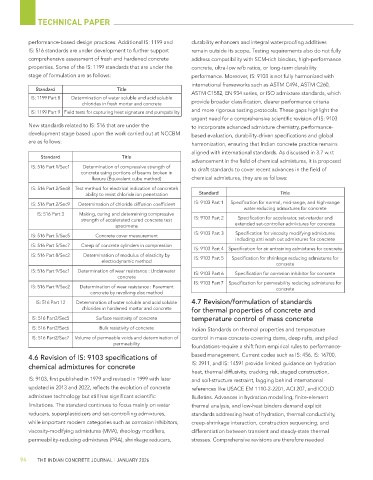
           stage of formulation are as follows:                   performance. Moreover, IS: 9103 is not fully harmonized with
                                                                  international frameworks such as ASTM C494, ASTM C260,
             Standard                    Title
                                                                  ASTM C1582, EN 934 series, or ISO admixture standards, which
           IS: 1199 Part 8  Determination of water soluble and acid soluble
                             chlorides in fresh mortar and concrete  provide broader classification, clearer performance criteria
           IS: 1199 Part 9 Field tests for capturing heat signature and pumpability   and more rigorous testing protocols. These gaps highlight the
                                                                  urgent need for a comprehensive scientific revision of IS: 9103
           New standards related to IS: 516 that are under the    to incorporate advanced admixture chemistry, performance-
           development stage based upon the work carried out at NCCBM   based evaluation, durability‑driven specifications and global
           are as follows:                                        harmonization, ensuring that Indian concrete practice remains

                                                                  aligned with international standards. As discussed in 3.7 w.r.t
               Standard                   Title
                                                                  advancement in the field of chemical admixtures, it is proposed
            IS: 516 Part 1/Sec1  Determination of compressive strength of   to draft standards to cover recent advances in the field of
                            concrete using portions of beams broken in
                                flexure (Equivalent cube method)  chemical admixtures, they are as follows:
            IS: 516 Part 2/Sec8  Test method for electrical indication of concrete’s
                              ability to resist chloride ion penetration  Standard              Title
            IS: 516 Part 2/Sec9  Determination of chloride diffusion coefficient  IS: 9103 Part 1  Specification for normal, mid‑range, and high‑range
                                                                                   water-reducing admixtures for concrete
              IS: 516 Part 3  Making, curing and determining compressive
                            strength of accelerated cured concrete test   IS: 9103 Part 2  Specification for accelerator, set‑retarder and
                                        specimens                               extended set-controller admixtures for concrete
            IS: 516 Part 5/Sec5  Concrete cover measurement       IS: 9103 Part 3  Specification for viscosity modifying admixtures
                                                                                including anti wash out admixtures for concrete
            IS: 516 Part 5/Sec7  Creep of concrete cylinders in compression
                                                                  IS: 9103 Part 4  Specification for air entraining admixtures for concrete
            IS: 516 Part 8/Sec2  Determination of modulus of elasticity by   IS: 9103 Part 5  Specification for shrinkage reducing admixtures for
                                   electrodynamic method
                                                                                              concrete
            IS: 516 Part 9/Sec1  Determination of wear resistance : Underwater   IS: 9103 Part 6  Specification for corrosion inhibitor for concrete
                                         concrete
                                                                  IS: 9103 Part 7  Specification for permeability reducing admixtures for
            IS: 516 Part 9/Sec2  Determination of wear resistance : Pavement                  concrete
                                concrete by revolving disc method
             IS: 516 Part 12  Determination of water soluble and acid soluble   4.7 Revision/formulation of standards
                             chlorides in hardened mortar and concrete
                                                                  for thermal properties of concrete and
            IS: 516 Part2/Sec5   Surface resistivity of concrete   temperature control of mass concrete
            IS: 516 Part2/Sec6     Bulk resistivity of concrete   Indian Standards on thermal properties and temperature
            IS: 516 Part2/Sec7  Volume of permeable voids and determination of   control in mass concrete-covering dams, deep rafts, and piled
                                       permeability
                                                                  foundations-require a shift from empirical rules to performance-
           4.6 Revision of IS: 9103 specifications of             based management. Current codes such as IS: 456, IS: 16700,
                                                                  IS: 2911, and IS: 14591 provide limited guidance on hydration
           chemical admixtures for concrete
                                                                  heat, thermal diffusivity, cracking risk, staged construction,
           IS: 9103, first published in 1979 and revised in 1999 with later   and soil-structure restraint, lagging behind international
           updated in 2013 and 2022, reflects the evolution of concrete   references like USACE EM 1110-2-2201, ACI 207, and ICOLD
           admixture technology but still has significant scientific   Bulletins. Advances in hydration modelling, finite‑element
           limitations. The standard continues to focus mainly on water   thermal analysis, and low-heat binders demand explicit
           reducers, superplasticizers and set-controlling admixtures,   standards addressing heat of hydration, thermal conductivity,
           while important modern categories such as corrosion inhibitors,   creep-shrinkage interaction, construction sequencing, and
           viscosity‑modifying admixtures (VMA), rheology modifiers,   differentiation between transient and steady-state thermal
           permeability-reducing admixtures (PRA), shrinkage reducers,   stresses. Comprehensive revisions are therefore needed


        94    THE INDIAN CONCRETE JOURNAL | JANUARY 2026

