


Page 12 - ICJ Jan 2026
P. 12
TECHNICAL PAPER


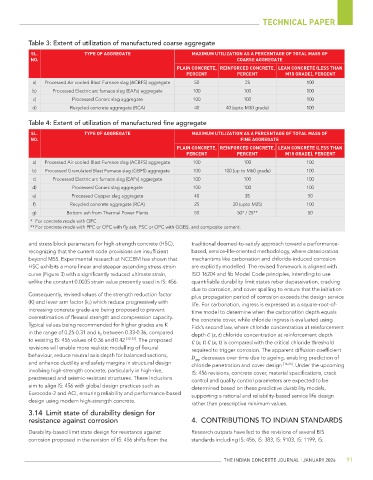
           Table 3: Extent of utilization of manufactured coarse aggregate

            SL.               TYPE OF AGGREGATE                   MAXIMUM UTILIZATION AS A PERCENTAGE OF TOTAL MASS OF
           NO.                                                                   COARSE AGGREGATE
                                                             PLAIN CONCRETE, REINFORCED CONCRETE,  LEAN CONCRETE (LESS THAN
                                                                PERCENT          PERCENT         M15 GRADE), PERCENT
            a)  Processed Air cooled Blast Furnace slag (ACBFS) aggregate  50       25                  100
            b)     Processed Electric arc furnace slag (EAFs) aggregate   100      100                  100
            c)           Processed Conarc slag aggregate          100              100                  100
            d)           Recycled concrete aggregate (RCA)         40        40 (upto M30 grade)        100

           Table 4: Extent of utilization of manufactured fine aggregate

           SL.               TYPE OF AGGREGATE                    MAXIMUM UTILIZATION AS A PERCENTAGE OF TOTAL MASS OF
           NO.                                                                    FINE AGGREGATE
                                                             PLAIN CONCRETE, REINFORCED CONCRETE,  LEAN CONCRETE (LESS THAN
                                                                PERCENT          PERCENT         M15 GRADE), PERCENT
            a)  Processed Air cooled Blast Furnace slag (ACBFS) aggregate   100    100                  100
            b)  Processed Granulated Blast Furnace slag (GBFS) aggregate  100  100 (up to M60 grade)    100
            c)     Processed Electric arc furnace slag (EAFs) aggregate  100       100                  100
            d)           Processed Conarc slag aggregate          100              100                  100
            e)           Processed Copper slag aggregate           40               35                   50
            f)           Recycled concrete aggregate (RCA)         25           20 (upto M25)           100
            g)         Bottom ash from Thermal Power Plants        50            50* / 25**              50
           *  For concrete made with OPC
           ** For concrete made with PPC or OPC with fly ash, PSC or OPC with GGBS, and composite cement.


           and stress block parameters for high-strength concrete (HSC),   traditional deemed-to-satisfy approach toward a performance-
           recognizing that the current code provisions are insufficient   based, service-life-oriented methodology, where deterioration
           beyond M55. Experimental research at NCCBM has shown that   mechanisms like carbonation and chloride-induced corrosion
           HSC exhibits a more linear and steeper ascending stress-strain   are explicitly modelled. The revised framework is aligned with
           curve (Figure 3) with a significantly reduced ultimate strain,   ISO 16204 and fib Model Code principles, intending to use
           unlike the constant 0.0035 strain value presently used in IS: 456.   quantifiable durability limit states rebar depassivation, cracking
                                                                  due to corrosion, and cover spalling to ensure that the initiation
           Consequently, revised values of the strength reduction factor   plus propagation period of corrosion exceeds the design service
           (K) and lever arm factor (k 2 ) which reduce progressively with   life. For carbonation, ingress is expressed as a square-root-of-
           increasing concrete grade-are being proposed to prevent   time model to determine when the carbonation depth equals
           overestimation of flexural strength and compression capacity.   the concrete cover, while chloride ingress is evaluated using
           Typical values being recommended for higher grades are K   Fick’s second law, where chloride concentration at reinforcement
           in the range of 0.25-0.31 and k 2  between 0.33-0.36, compared   depth    (  ,    ) chloride concentration at reinforcement depth
           to existing IS: 456 values of 0.36 and 0.42  [32-33] . The proposed      (  ,    )    (  ,    ) is compared with the critical chloride threshold
           revisions will enable more realistic modelling of flexural   required to trigger corrosion. The apparent diffusion coefficient
           behaviour, reduce neutral axis depth for balanced sections,   D app  decreases over time due to ageing, enabling prediction of
           and enhance ductility and safety margins in structural design   chloride penetration and cover design  [16,25] . Under the upcoming
           involving high-strength concrete, particularly in high-rise,   IS: 456 revisions, concrete cover, material specifications, crack
           prestressed and seismic-resistant structures. These inclusions   control and quality control parameters are expected to be
           aim to align IS: 456 with global design practices such as   determined based on these predictive durability models,
           Eurocode-2 and ACI, ensuring reliability and performance-based   supporting a rational and reliability-based service life design
           design using modern high-strength concrete.
                                                                  rather than prescriptive minimum values.
           3.14  Limit state of durability design for
           resistance against corrosion                           4.  CONTRIBUTIONS TO INDIAN STANDARDS
           Durability-based limit state design for resistance against   Research outputs have led to the revisions of several BIS
           corrosion proposed in the revision of IS: 456 shifts from the   standards including IS: 456, IS: 383, IS: 9103, IS: 1199, IS:


                                                                            THE INDIAN CONCRETE JOURNAL | JANUARY 2026  91

