


Page 9 - ICJ Jan 2026
P. 9
TECHNICAL PAPER


           ambient-curing capability, and stable slump retention-critical   using these aggregates demonstrated that structural-grade
           requirements for RMC operations. Laboratory investigations   strength levels up to M35 can be achieved. Fresh property
           confirmed strong performance across strength, modulus,   assessments indicated adequate workability, while mechanical
           permeability, resistivity, chloride diffusion, and corrosion   testing lead to the development of various constitutive
           resistance metrics, matching or exceeding OPC concrete. The   relationship between properties like flexural strength  [38] ,
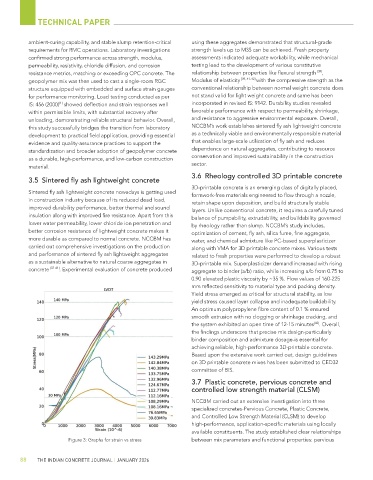
           geopolymer mix was then used to cast a single-room RGC   Modulus of elasticity  [39, 41-42]  with the compressive strength as the
           structure equipped with embedded and surface strain gauges   conventional relationship between normal weight concrete does
           for performance monitoring. Load testing conducted as per    not stand valid for light weight concrete and same has been
                     [1]
           IS: 456 (2000)  showed deflection and strain responses well   incorporated in revised IS: 9142. Durability studies revealed
           within permissible limits, with substantial recovery after   favorable performance with respect to permeability, shrinkage,
           unloading, demonstrating reliable structural behavior. Overall,   and resistance to aggressive environmental exposure. Overall,
           this study successfully bridges the transition from laboratory   NCCBM’s work establishes sintered fly ash lightweight concrete
           development to practical field application, providing essential   as a technically viable and environmentally responsible material
           evidence and quality-assurance practices to support the   that enables large‑scale utilization of fly ash and reduces
           standardization and broader adoption of geopolymer concrete   dependence on natural aggregates, contributing to resource
           as a durable, high-performance, and low-carbon construction   conservation and improved sustainability in the construction
           material.                                              sector.
                                                                  3.6  Rheology controlled 3D printable concrete
           3.5  Sintered fly ash lightweight concrete
                                                                  3D-printable concrete is an emerging class of digitally placed,
           Sintered fly ash lightweight concrete nowadays is getting used   formwork‑free materials engineered to flow through a nozzle,
           in construction industry because of its reduced dead load,   retain shape upon deposition, and build structurally stable
           improved durability performance, better thermal and sound   layers. Unlike conventional concrete, it requires a carefully tuned
           insulation along with improved fire resistance. Apart from this   balance of pumpability, extrudability, and buildability governed
           lower water permeability, lower chloride ion penetration and   by rheology rather than slump. NCCBM’s study includes,
           better corrosion resistance of lightweight concrete makes it   optimization of cement, fly ash, silica fume, fine aggregate,
           more durable as compared to normal concrete. NCCBM has   water, and chemical admixture like PC-based superplasticizer
           carried out comprehensive investigations on the production   along with VMA for 3D printable concrete mixes. Various tests
           and performance of sintered fly ash lightweight aggregates   related to fresh properties were performed to develop a robust
           as a sustainable alternative to natural coarse aggregates in   3D-printable mix. Superplasticizer demand increased with rising
           concrete  [37-41] . Experimental evaluation of concrete produced   aggregate to binder (a/b) ratio, while increasing a/b from 0.75 to
                                                                  0.90 elevated plastic viscosity by ~35 %. Flow values of 160-225
                                                                  mm reflected sensitivity to material type and packing density.
                                                                  Yield stress emerged as critical for structural stability, as low
                                                                  yield stress caused layer collapse and inadequate buildability.
                                                                  An optimum polypropylene fibre content of 0.1 % ensured
                                                                  smooth extrusion with no clogging or shrinkage cracking, and
                                                                  the system exhibited an open time of 12-15 minutes . Overall,
                                                                                                           [42]
                                                                  the findings underscore that precise mix design‑particularly
                                                                  binder composition and admixture dosage-is essential for
                                                                  achieving reliable, high-performance 3D-printable concrete.
                                                                  Based upon the extensive work carried out, design guidelines
                                                                  on 3D printable concrete mixes has been submitted to CED32
                                                                  committee of BIS.

                                                                  3.7  Plastic concrete, pervious concrete and
                                                                  controlled low strength material (CLSM)
                                                                  NCCBM carried out an extensive investigation into three
                                                                  specialized concretes-Pervious Concrete, Plastic Concrete,
                                                                  and Controlled Low Strength Material (CLSM) to develop
                                                                  high‑performance, application‑specific materials using locally
                                                                  available constituents. The study established clear relationships
                        Figure 3: Graphs for strain vs stress     between mix parameters and functional properties: pervious


        88    THE INDIAN CONCRETE JOURNAL | JANUARY 2026

