


Page 5 - ICJ Jan 2026
P. 5
TECHNICAL PAPER


           corrosion behaviour have resulted in scientifically justified   technology in India over the past decade and provide the
           limits for clinker reduction and optimized blend proportions.   framework for the detailed technical discussions presented
           The outcomes of these studies have provided a technical basis   in the subsequent sections of this manuscript. Anchored
           for new and revised cement standards aimed at reducing the   in research-driven principles, the group has systematically
           carbon footprint of cementitious materials while ensuring   translated sustainability, durability, and resource efficiency
           durability and long-term performance. In addition to material   into national standards, notably through the introduction of
                                                                                             [2]
           innovations, NCCBM has contributed to the advancement of   multi-source aggregates in IS: 383   and the formulation of a
           characterization techniques and performance-based evaluation   dedicated standard for geopolymer concrete (IS: 17452). The
           methodologies for emerging concretes, including high-  circular utilization of industrial by-products, recycled aggregates,
                                                           [20]
           performance concrete  [18-19] , ultra-high-performance concrete  ,   and construction and demolition (C&D) waste supports a circular
           geopolymer concrete, lightweight concrete, roller-compacted   economy by reducing clinker consumption, conserving natural
           concrete, and rheology-controlled 3D-printable concrete.   aggregates, and lowering embodied carbon. Simultaneously,
                                                                  rigorous scientific evaluation of transport properties,
           These efforts have led to improved understanding of
                                                                  permeability, cracking behaviour, and long-term deformation
           mechanical behaviour, durability indices, rheological control,
           thermal response, and corrosion mitigation, supporting a   ensures durability under diverse exposure conditions. By
           shift from prescriptive requirements to performance-oriented   explicitly linking material composition and microstructure
           design and quality control. The generated knowledge has   with exposure‑specific performance, these standards facilitate
           been systematically integrated into revisions of major Indian   performance-based and service-life-oriented design while
           Standards such as IS: 456, IS: 516, IS: 1199, IS: 9103, IS: 383, and   mitigating common infrastructure failures such as premature
           IS: 2386  [1-6]  given below in Table 1. The broader impact of these   reinforcement corrosion and excessive deflections. Collectively,
           contributions extends to industry practice, academic research,   this approach reframes sustainability from mere material
           and community outreach. Collaborative projects with academic   substitution to a reliability-driven engineering paradigm.
           institutions such as IITs, infrastructure agencies, and industry
           stakeholders such as Ultratech, JSW, Tata Steel, SAIL, AMNS etc.   2. RESEARCH VISION AND PHILOSOPHY
           have facilitated technology transfer, pilot-scale demonstrations,   The group follows a research philosophy centered on (i) circular
           and capacity building. The research outputs have informed   use of materials, (ii) scientific characterization of concrete
           academic studies through validated experimental evidence   properties across scales, (iii) multi-mechanism durability studies,
           and constitutive models, strengthened industry confidence   and (iv) translation of research into national standards. Emphasis
           in sustainable materials, and supported the development of   is placed on blue-sky research that explores fundamental
           national policies and standards.                       mechanisms governing hydration, microstructure evolution,
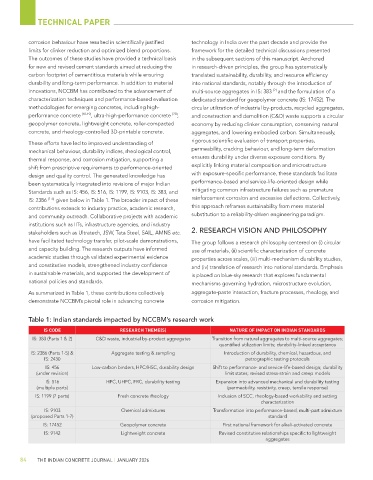
           As summarized in Table 1, these contributions collectively   aggregate-paste interaction, fracture processes, rheology, and
           demonstrate NCCBM’s pivotal role in advancing concrete   corrosion mitigation.


           Table 1: Indian standards impacted by NCCBM’s research work
                IS CODE                  RESEARCH THEME(S)                    NATURE OF IMPACT ON INDIAN STANDARDS
            IS: 383 (Parts 1 & 2)  C&D waste, industrial by-product aggregates  Transition from natural aggregates to multi-source aggregates;
                                                                           quantified utilization limits; durability‑linked acceptance
           IS: 2386 (Parts 1-5) &      Aggregate testing & sampling          Introduction of durability, chemical, hazardous, and
                IS: 2430                                                            petrographic testing protocols
                IS: 456         Low-carbon binders, HPC/HSC, durability design  Shift to performance- and service-life-based design; durability
             (under revision)                                                limit states; revised stress-strain and creep models
                IS: 516              HPC, UHPC, FRC, durability testing   Expansion into advanced mechanical and durability testing
             (multiple parts)                                                 (permeability, resistivity, creep, tensile response)
             IS: 1199 (7 parts)          Fresh concrete rheology           Inclusion of SCC, rheology-based workability and setting
                                                                                         characterization
                IS: 9103                  Chemical admixtures            Transformation into performance-based, multi-part admixture
            (proposed Parts 1-7)                                                           standard
                IS: 17452                 Geopolymer concrete               First national framework for alkali-activated concrete
                IS: 9142                  Lightweight concrete             Revised constitutive relationships specific to lightweight
                                                                                           aggregates


        84    THE INDIAN CONCRETE JOURNAL | JANUARY 2026

