


Page 110 - ICJ Jan 2023
P. 110
TECHNICAL PAPER                                            COLLECTOR’S EDITION


                              2002,  to  concentrate  on  RA  (recycled  aggregate  STRENGTH AND DEFORMATION
                              containing lower quantities of crushed concrete).   CHARACTERISTICS
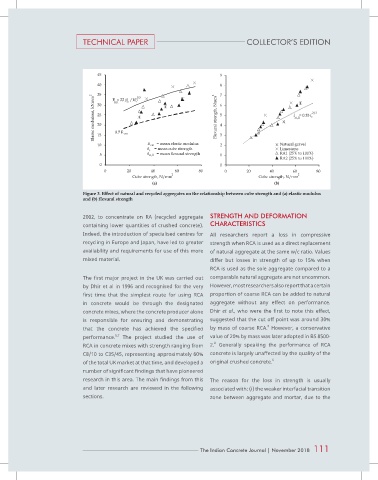
                              Indeed, the introduction of specialised centres for   All  researchers  report  a  loss  in  compressive
                              recycling in Europe and Japan, have led to greater   strength when RCA is used as a direct replacement
                              availability and requirements for use of this more   of natural aggregate at the same w/c ratio. Values
                              mixed material.                               differ  but  losses  in  strength  of  up  to  15%  when
                                                                            RCA is used as the sole aggregate compared to a
                              The first major project in the UK was carried out   comparable natural aggregate are not uncommon.
                              by Dhir et al in 1996 and recognised for the very   However, most researchers also report that a certain
                              first  time  that  the  simplest  route  for  using  RCA   proportion of coarse RCA can be added to natural
                              in  concrete  would be through the  designated   aggregate without any effect on performance.
                              concrete mixes, where the concrete producer alone   Dhir et al., who were the first to note this effect,
                              is  responsible for ensuring and demonstrating   suggested that the cut off point was around 30%
                                                                                                6
                              that  the  concrete  has  achieved  the  specified   by mass of coarse RCA.  However, a conservative
                                          6,7
                              performance.   The project  studied the  use  of   value of 20% by mass was later adopted in BS 8500-
                                                                             8
                              RCA in concrete mixes with strength ranging from   2.   Generally  speaking  the  performance  of  RCA
                              C8/10 to C35/45, representing approximately 60%   concrete is largely unaffected by the quality of the
                              of the total UK market at that time, and developed a   original crushed concrete. 6
                              number of significant findings that have pioneered
                              research in this area. The main findings from this   The reason for the loss  in strength is  usually
                              and later research are reviewed in the following   associated with: (i) the weaker interfacial transition
                              sections.                                     zone  between  aggregate  and  mortar,  due  to  the


                                                                        The Indian Concrete Journal | November 2018  111

