


Page 112 - ICJ Jan 2023
P. 112
TECHNICAL PAPER                                            COLLECTOR’S EDITION


                              However,  up  about  20%  by  mass  of  aggregate,
                              the  shrinkage  of  RCA,  RA  and  the  equivalent
                              natural  aggregate  concrete  can assumed to  be
                                         16
                              comparable.  Furthermore, there are very  few
                              examples of RA concrete with shrinkage levels that
                              fall outside the upper limit of 0.075% permitted for
                              aggregates in BS EN 12620. In addition, it should be
                              noted that some tests have shown RA concretes to
                              have lower shrinkage than equivalent RCA and NA
                                       23
                              concretes.

                              There is limited research on the effect of recycled
                              aggregate concrete on creep. However, as creep
                              may be related to the elastic modulus  of the
                              aggregate, and in  turn the  elastic  modulus of
                              concrete,  in general,  results  suggests that  creep
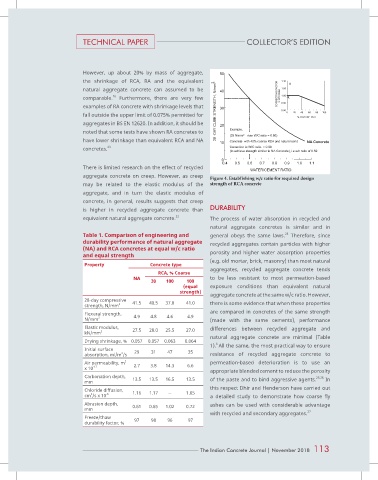
                              is higher in recycled aggregate concrete than   DURABILITY
                                                               23
                              equivalent natural aggregate concrete.        The process of water absorption in recycled and
                                                                            natural aggregate concretes is similar and  in
                                                                                                      24
                              Table 1. Comparison of engineering and        general  obeys  the  same  laws.   Therefore,  since
                              durability performance of natural aggregate   recycled aggregates contain particles with higher
                              (NA) and RCA concretes at equal w/c ratio     porosity  and higher water absorption properties
                              and equal strength
                                                                            (e.g. old mortar, brick, masonry) than most natural
                               Property               Concrete type
                                                                            aggregates,  recycled  aggregate  concrete  tends
                                                         RCA, % Coarse
                                                NA                          to be less resistant to most permeation-based
                                                       30   100    100
                                                                  (equal    exposure conditions than equivalent natural
                                                                 strength)
                                                                            aggregate concrete at the same w/c ratio. However,
                               28-day compressive   41.5  40.5  37.0  41.0  there is some evidence that when these properties
                               strength, N/mm 2
                               Flexural strength,   4.9  4.8  4.6  4.9      are compared in concretes  of the same strength
                               N/mm 2                                       (made  with  the  same  cements),  performance
                               Elastic modulus,   27.5  28.0  25.5  27.0    differences  between recycled  aggregate  and
                               kN/mm 2
                                                                            natural  aggregate  concrete  are  minimal  (Table
                               Drying shrinkage, % 0.057  0.057  0.063  0.064
                                                                              6
                                                                            1). All the same, the most practical way to ensure
                               Initial surface   29    31   47      35
                                            2
                               absorption, ml/m /s                          resistance  of recycled  aggregate concrete  to
                               Air permeability, m 2   2.7  3.8  14.3  6.6  permeation-based deterioration  is  to  use  an
                               x 10 -17
                                                                            appropriate blended cement to reduce the porosity
                               Carbonation depth,   13.5  13.5  16.5  13.5  of the paste and to bind aggressive agents. 25,26  In
                               mm
                                                                            this respect Dhir and Henderson have carried out
                               Chloride diffusion,   1.16  1.17  --  1.05
                                 2
                               cm /s x 10 -6                                a  detailed  study  to  demonstrate  how  coarse  fly
                               Abrasion depth,                              ashes can be used with considerable advantage
                               mm               0.61  0.65  1.02   0.72
                                                                            with recycled and secondary aggregates. 27
                               Freeze/thaw       97    98   96      97
                               durability factor, %


                                                                        The Indian Concrete Journal | November 2018  113

