


Page 117 - ICJ Jan 2023
P. 117
TECHNICAL PAPER                                            COLLECTOR’S EDITION


                                 2.  Manufactured  aggregates,  are  of mineral   Constituent  Content (% by mass)  Category
                                    origin resulting from industrial process
                                    involving thermal or other modification, and              < 50         Rcu  Declared
                                                                                          No requirement     Rcu  NR
                                 3.  Recycled  aggregates,  result  from  the
                                                                                Rb            ≤ 10            Rb
                                    processing of inorganic material previously                                 10
                                    used  in  construction.  However,  BS  EN                 ≤ 30            Rb  30
                                    12620 provides no guidance on how these                   ≤ 50            Rb  50
                                    different aggregates may be used.                         > 50          Rb  Declared

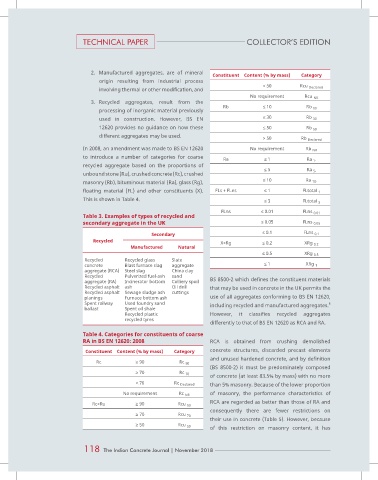
                              In 2008, an amendment was made to BS EN 12620               No requirement     Rb  NR
                              to  introduce a number of categories for coarse   Ra             ≤ 1            Ra
                              recycled  aggregate based on the proportions of                                   1-
                                                                                               ≤ 5            Ra  5-
                              unbound stone (Ru), crushed concrete (Rc), crushed
                              masonry (Rb), bituminous material (Ra), glass (Rg),             ≤ 10           Ra  10-
                              floating  material  (FL)  and  other  constituents  (X).   FLs + FLns  ≤ 1    FLtotal  1
                              This is shown in Table 4.                                        ≤ 3          FLtotal  3

                                                                               FLns           ≤ 0.01        FLns  0.01
                              Table 3. Examples of types of recycled and
                              secondary aggregate in the UK                                   ≤ 0.05        FLns  0.05

                                                       Secondary                              ≤ 0.1          FLns  0.1
                                  Recycled                                     X+Rg           ≤ 0.2          XRg
                                               Manufactured     Natural                                         0.2
                                                                                              ≤ 0.5          XRg  0.5
                               Recycled      Recycled glass   Slate
                               concrete      Blast furnace slag  aggregate                     ≤ 1            XRg  1
                               aggregate (RCA)  Steel slag    China clay
                               Recycled      Pulverized fuel-ash  sand
                               aggregate (RA)  Incinerator bottom   Colliery spoil  BS 8500-2 which defines the constituent materials
                               Recycled asphalt  ash          Oil drill     that may be used in concrete in the UK permits the
                               Recycled asphalt  Sewage sludge ash  cuttings
                               planings      Furnace bottom ash             use of all aggregates conforming to BS EN 12620,
                               Spent railway   Used foundry sand            including recycled and manufactured aggregates.
                                                                                                                      8
                               ballast       Spent oil shale
                                             Recycled plastic               However,   it   classifies   recycled   aggregates
                                             recycled tyres
                                                                            differently to that of BS EN 12620 as RCA and RA.
                              Table 4. Categories for constituents of coarse
                              RA in BS EN 12620: 2008                       RCA  is  obtained  from  crushing  demolished
                               Constituent  Content (% by mass)  Category   concrete structures, discarded precast elements
                                                                            and unused hardened concrete, and by definition
                                   Rc            ≥ 90            Rc  90
                                                                            (BS  8500-2)  it  must  be  predominately  composed
                                                 ≥ 70            Rc  70     of concrete (at least 83.5% by mass) with no more
                                                 < 70          Rc  Declared  than 5% masonry. Because of the lower proportion
                                             No requirement     Rc  NR      of masonry, the performance characteristics of

                                  Rc+Ru          ≥ 90           Rcu  90     RCA are regarded as better than those of RA and
                                                                            consequently there are fewer restrictions  on
                                                 ≥ 70           Rcu  70
                                                                            their use in concrete (Table 5). However, because
                                                 ≥ 50           Rcu  50     of this restriction on masonry content, it  has


                               118 The Indian Concrete Journal | November 2018

