


Page 115 - ICJ Jan 2023
P. 115
TECHNICAL PAPER                                            COLLECTOR’S EDITION


                              Materials  Decree  which  is  likely  to  be  the  basis   a new project starts. The main alternative  to
                              for revisions to Essential Requirement 3 (ER3). 35,36    using recycled  aggregates is,  of course, natural
                              A  further  study  using  EA  NEN  7345  method  has   aggregate and these are still  relatively  low cost
                              shown that concrete made with aggregates at the   materials. However, in a purely economic balance,
                              very extreme of composition (e.g. using incinerator   the cost of processing to recycled aggregates in the
                              bottom  ash  aggregate)  still  satisfies  the  BMD.   UK is becoming less than that of disposing of the
                              A  similar  leaching  study  on  foamed  recycled   demolition waste and purchasing new aggregates,
                              aggregate  concrete  using  the  EA  NEN  7345   due  to  increases  in  landfill  tax  and  the  newly
                              method has also demonstrated that there was no   introduced aggregate levy. If recycled aggregates
                              significant difference in Cd, Cu, Pb and Zn leaching   have to be transported a significant distance from
                              between foamed concrete containing RA and other   the place of production to the place of use, then
                                         37
                              aggregates.                                   both  the  cost  and  environmental  benefits  may
                                                                            become more questionable.
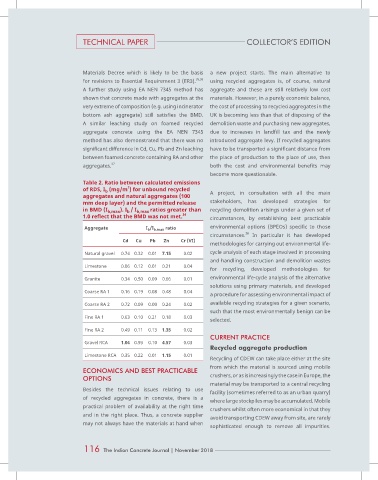
                              Table 2. Ratio between calculated emissions
                                              2
                              of RDS, I  (mg/m ) for unbound recycled       A  project,  in  consultation  with  all  the  main
                                      b
                              aggregates and natural aggregates (100
                              mm deep layer) and the permitted release      stakeholders, has developed strategies  for
                              in BMD (I b,max ). I / I b,max  ratios greater than   recycling demolition arisings under a given set of
                                              b
                              1.0 reflect that the BMD was not met. 34      circumstances,  by  establishing  best  practicable
                               Aggregate             I /I b,max  ratio      environmental  options  (BPEOs)  specific  to  those
                                                     b
                                                                            circumstances.   In  particular  it  has  developed
                                                                                        38
                                             Cd  Cu   Pb   Zn    Cr (VI)
                                                                            methodologies for carrying out environmental life-
                               Natural gravel  0.74 0.32  0.01  7.15  0.02  cycle analysis of each stage involved in processing
                                                                            and handling construction and demolition wastes
                               Limestone    0.06 0.12  0.01  0.21  0.04
                                                                            for recycling,  developed  methodologies  for
                               Granite      0.34 0.50  0.09  0.66  0.01     environmental life-cycle analysis of the alternative
                                                                            solutions using primary materials, and developed
                               Coarse RA 1  0.16 0.19  0.08  0.48  0.04
                                                                            a procedure for assessing environmental impact of
                               Coarse RA 2  0.72 0.09  0.00  0.24  0.02     available recycling strategies for a given scenario,
                                                                            such that the most environmentally benign can be
                               Fine RA 1    0.63 0.10  0.21  0.18  0.03     selected.
                               Fine RA 2    0.49 0.11  0.13  1.35  0.02
                                                                            CURRENT PRACTICE
                               Gravel RCA   1.04 0.93  0.10  4.57  0.03
                                                                            Recycled aggregate production
                               Limestone RCA  0.35 0.22  0.01  1.15  0.01
                                                                            Recycling of CDEW can take place either at the site
                                                                            from which the material  is sourced using mobile
                              ECONOMICS AND BEST PRACTICABLE
                              OPTIONS                                       crushers, or as is increasingly the case in Europe, the
                                                                            material may be transported to a central recycling
                              Besides  the  technical  issues  relating  to  use
                                                                            facility (sometimes referred to as an urban quarry)
                              of recycled aggregates in concrete, there is a
                                                                            where large stockpiles may be accumulated. Mobile
                              practical  problem of availability  at the right time
                                                                            crushers whilst often more economical in that they
                              and in the right place. Thus, a concrete supplier
                                                                            avoid transporting CDEW away from site, are rarely
                              may not always have the materials at hand when
                                                                            sophisticated enough  to remove all impurities.


                               116 The Indian Concrete Journal | November 2018

