


Page 120 - ICJ Jan 2023
P. 120
TECHNICAL PAPER                                            COLLECTOR’S EDITION


                              Table 7. Availability of selected RSA in the UK

                               Material        Waste       Amount to                   Uses in concrete
                                             generation     landfill
                                             (per annum)  (per annum)
                               Glass Cullet  1.7 m tonnes  1.3 m tonnes  Crushed glass may be used as fine aggregate, and very fine
                                                                      particles may have pozzolanic properties.
                               Incinerator Ash  0.5 m tonnes  0.5 m tonnes  Bottom ash may be developed as a lightweight aggregate. Fly
                                                                      ash used as a filler material.

                               Used Tyres   37 million tyres  banned since   Used to improve thermal and sound properties of concrete,
                                                             2008     increase freeze-thaw resistance and provide impact resistance.
                               Oil Drill     0.3 m tonnes  0.3 m tonnes  Whole or partial replacement of fine aggregate.
                               Cuttings

                                 •  Class  B  –  covering  most  combinations  of   aggregates  is  more  contentious  than
                                    natural and recycled aggregate and suitable   recycled  aggregates  despite  their  inclusion  in
                                    for most ‘moderate’ exposure conditions;   BS EN 12620.  For one, concrete should not be seen
                                                                                      5
                                    and                                     as an alternative form of landfill, and furthermore
                                                                            many of these materials will only ever be suitable
                                 •  Class C – those aggregates suitable for only
                                    the ‘mildest’ exposure conditions.      for low-value  concretes.  However,  this  is  again
                                                                            where the concept of appropriate use of materials
                              Consequently,  the  project  provided  the  technical   is important, and research undertaken by Dhir et al
                              details  required to  increase the use of recycled   and others has shown that used appropriately in,
                              aggregate in concrete, and  give industry greater
                              confidence  and  informing  future  revisions  to  the   for example, general grade concrete, foundations
                              concrete standard.                            and low quality pavements which make  up over
                                                                            75%  of  all  concrete  use,  there  is  scope  for  using
                                                                            enormous quantities  of crushed glass,  municipal
                              SECONDARY AGGREGATES
                                                                            solid waste incinerator bottom ash, oil drill cuttings
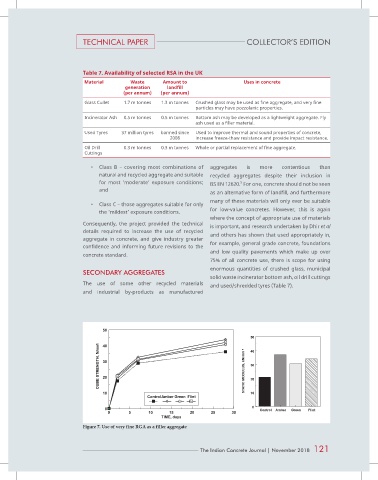
                              The use  of some  other  recycled  materials   and used/shredded tyres (Table 7).
                              and industrial  by-products as  manufactured


                                                                        The Indian Concrete Journal | November 2018  121

