


Page 119 - ICJ Jan 2023
P. 119
TECHNICAL PAPER                                            COLLECTOR’S EDITION


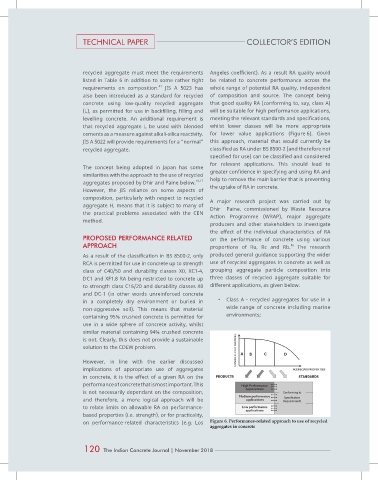
                              recycled aggregate must meet the requirements   Angeles coefficient). As a result RA quality would
                              listed  in Table 6 in addition to some rather tight   be related to  concrete  performance across  the
                                                         41
                              requirements on composition.   JIS  A  5023  has   whole range of potential RA quality, independent
                              also been introduced  as a standard for recycled   of composition and source. The concept being
                              concrete  using low-quality  recycled  aggregate   that good quality RA (conforming to, say, class A)
                              (L), as permitted for use in backfilling, filling and   will be suitable for high performance applications,
                              levelling  concrete.  An  additional  requirement  is   meeting the relevant standards and specifications,
                              that  recycled  aggregate  L  be  used  with  blended   whilst  lower classes  will  be more appropriate
                              cements as a measure against alkali-silica reactivity.   for  lower  value  applications  (Figure 6).  Given
                              JIS A 5022 will provide requirements for a “normal”   this approach, material that would  currently be
                              recycled aggregate.                           classified as RA under BS 8500-2 (and therefore not
                                                                            specified for use) can be classified and considered
                                                                            for relevant  applications. This should lead to
                              The concept  being adopted in  Japan has some
                              similarities with the approach to the use of recycled   greater confidence in specifying and using RA and
                              aggregates proposed by Dhir and Paine below. 16,17    help to remove the main barrier that is preventing
                              However,  the  JIS  reliance  on  some  aspects  of   the uptake of RA in concrete.
                              composition, particularly with respect to recycled   A  major  research  project  was  carried  out  by
                              aggregate H, means that it is subject to many of   Dhir    Paine,  commissioned  by  Waste  Resource
                              the  practical  problems  associated  with  the  CEN   Action  Programme  (WRAP),  major  aggregate
                              method.
                                                                            producers and other stakeholders to investigate
                                                                            the  effect  of  the  individual  characteristics  of  RA
                              PROPOSED PERFORMANCE RELATED                  on the  performance  of concrete  using various
                              APPROACH                                      proportions  of  Ru,  Rc  and  Rb.  The research
                                                                                                        16
                              As a result of the classification in BS 8500-2, only   produced general guidance supporting the wider
                              RCA is permitted for use in concrete up to strength   use of recycled aggregates in concrete as well as
                              class  of  C40/50  and  durability  classes  X0,  XC1-4,   grouping aggregate particle composition into
                              DC1 and XF1.8 RA being restricted to concrete up   three  classes  of recycled  aggregate  suitable  for
                              to strength class C16/20 and durability classes X0   different applications, as given below.
                              and  DC-1  (in  other  words  unreinforced  concrete
                              in  a completely  dry environment or buried in   •  Class A - recycled aggregates for use in a
                              non-aggressive  soil).  This  means  that  material   wide range of concrete including marine
                              containing 95% crushed concrete is permitted for   environments;
                              use  in  a  wide  sphere  of concrete  activity,  whilst
                              similar material containing 94% crushed concrete
                              is not. Clearly, this does not provide a sustainable
                              solution to the CDEW problem.

                              However,  in  line  with  the  earlier  discussed
                              implications  of  appropriate  use  of  aggregates
                              in  concrete,  it  is  the  effect  of  a  given  RA  on  the
                              performance of concrete that is most important. This
                              is not necessarily dependant on the composition,
                              and therefore,  a  more  logical  approach  will  be
                              to  relate  limits  on  allowable  RA  on  performance-
                              based properties (i.e. strength), or for practicality,
                              on  performance-related  characteristics  (e.g.  Los


                               120 The Indian Concrete Journal | November 2018

