


Page 69 - ICJ Jan 2023
P. 69
TECHNICAL PAPER                                            COLLECTOR’S EDITION


                                  type. The degree of change in expansion due   It has also been found from the field observations
                                  to sand addition varies with the composition of   that these limits  are quite satisfactory from the
                                  a soil. For instance there is a 13 fold decrease in   point of view of durability aspects.
                                  the expansion value for BC soil with 5 percent
                                  cement  when the  sand content  of  the  soil  is   Some  of  the  soils  (like  ML  and  SH  soils)  do
                                  changed  from  35.7  percent  to  78.6  percent   not  show strength improvement  with  sand
                                  (clay reduces from 36 percent to 12 percent).  addition. However, these soils show much better

                                                                            durability  characteristics  with increased sand
                                                                            percentage. This shows that the presence of sand
                                                                            is critical to provide overall strength and durability
                                                                            characteristics in stabilised soil blocks.


                                                                            CONCLUSIONS
                                                                            Effect of soil composition/grading on the strength
                                                                            and durability characteristics of soil-cement blocks
                                                                            has been discussed. The following conclusions can
                                                                            be summarised from the results.


                                                                            (i)   Soil  composition/grading  has  a  significant
                                                                               influence  on  the  strength  and  durability
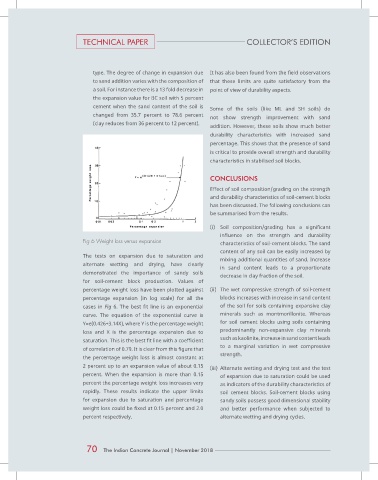
                              Fig 6 Weight loss versus expansion               characteristics of soil-cement blocks. The sand
                                                                               content of any soil can be easily increased by
                              The tests  on expansion due to saturation and
                                                                               mixing additional quantities of sand. Increase
                              alternate wetting and drying, have clearly
                                                                               in sand content leads to  a  proportionate
                              demonstrated  the  importance  of sandy  soils   decrease in clay fraction of the soil.
                              for soil-cement block production. Values of
                              percentage weight loss have been plotted against   (ii)   The wet compressive strength of soil-cement
                              percentage  expansion  (in  log  scale)  for  all  the   blocks increases with increase in sand content
                              cases  in  Fig  6.  The  best  fit  line  is  an  exponential   of the soil for soils containing expansive clay
                              curve.  The  equation  of the  exponential  curve  is    minerals such as montmorillonite.  Whereas
                              Y=e(0.426+3.14X), where Y is the percentage weight   for soil  cement blocks using soils  containing
                              loss  and  X  is  the  percentage  expansion  due  to   predominantly non-expansive clay  minerals
                              saturation. This is the best fit line with a coefficient   such as kaolinite, increase in sand content leads
                              of correlation of 0.79. It is clear from this figure that   to  a  marginal  variation  in  wet  compressive
                              the percentage weight loss is almost constant at   strength.
                              2 percent up to an expansion value of about 0.15   (iii)   Alternate wetting and drying test and the test
                              percent.  When  the  expansion  is  more  than  0.15   of expansion due to saturation could be used
                              percent the percentage weight loss increases very   as indicators of the durability characteristics of
                              rapidly. These results indicate the upper limits   soil  cement  blocks.  Soil-cement  blocks  using
                              for expansion due to  saturation and percentage   sandy soils possess good dimensional stability
                              weight loss could be fixed at 0.15 percent and 2.0   and  better performance  when  subjected to
                              percent respectively.                            alternate wetting and drying cycles.


                                70    The Indian Concrete Journal | November 2018

