


Page 66 - ICJ Jan 2023
P. 66
TECHNICAL PAPER                                            COLLECTOR’S EDITION


                                      some soils when the cement percentage is   Expansion due to saturation can be treated
                                      around 5.0. The increase in strength values   as  a  measure  of  dimensional  stability.  Block
                                      will  be  significant  for  soils  containing   performance when subjected to alternate wetting
                                      montmorillonite  clay  for low cement   and  drying  cycles  can  be  easily  quantified  by
                                      percentages of about 5 percent. There will   monitoring  the  weight  loss.  Details  of  these  two
                                      be marginal variation in strength for soils   tests conducted on pressed soil-cement cubes are
                                      containing only kaolinitic clay. However,   discussed in the following sections.
                                      for some soils strength decreases as
                                      the sand content goes up.  This may be
                                      attributed to reduction in clay size fraction
                                      containing some non-clay minerals which
                                      are  beneficial  for  strength  gain  due  to
                                      some secondary reactions such as lime-
                                      pozzolona reactions.


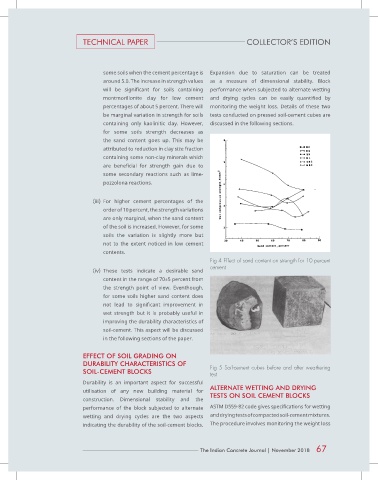
                                  (iii)   For  higher  cement  percentages  of  the
                                      order of 10 percent, the strength variations
                                      are only marginal, when the sand content
                                      of the soil is increased. However, for some
                                      soils the variation is slightly more but
                                      not  to  the  extent  noticed  in  low cement
                                      contents.
                                                                            Fig 4 Effect of sand content on strength for 10 percent
                                                                            cement
                                  (iv)   These  tests  indicate  a  desirable  sand
                                      content in the range of 70±5 percent from
                                      the  strength point of view. Eventhough,
                                      for some  soils  higher sand content  does
                                      not  lead  to  significant  improvement  in
                                      wet strength  but it is probably useful  in
                                      improving the durability characteristics of
                                      soil-cement. This aspect will be discussed
                                      in the following sections of the paper.


                              EFFECT OF SOIL GRADING ON
                              DURABILITY CHARACTERISTICS OF                 Fig 5 Soil-cement cubes before and after weathering
                              SOIL-CEMENT BLOCKS                            test

                              Durability  is  an  important  aspect  for  successful
                              utilisation  of any new building material  for   ALTERNATE WETTING AND DRYING
                              construction.  Dimensional  stability  and  the   TESTS ON SOIL CEMENT BLOCKS
                              performance  of the block subjected to alternate   ASTM D559-82 code gives specifications for wetting
                              wetting  and drying  cycles  are  the  two  aspects   and drying tests of compacted soil-cement mixtures.
                              indicating the durability of the soil-cement blocks.   The procedure involves monitoring the weight loss


                                                                        The Indian Concrete Journal | November 2018  67

