


Page 61 - ICJ Jan 2023
P. 61
TECHNICAL PAPER                                            COLLECTOR’S EDITION


                              understand the  strength and behaviour  of  soil-     (i)   The  compressive  strength  of  soil-cement
                              cement  mixtures,  using  local  soils.  Mitra  (1951)   blocks increases with an increase in cement
                              examined 9 types of local soils to determine their   content and block density. The strength
                              suitability for soil-cement houses near Rangawan    also increases with an increase in the
                              dam colony in India. One of his major findings is that   curing period and the curing temperature.
                              sandy soils with 5 percent cement give adequate
                              strength and protection against weathering.      (ii)   Dimensional  stability  and  resistance  to
                                                                                  softening action of water can be improved
                              A majority of the earlier examples of soil-cement   by cement stabilisation and densification.
                              buildings have rammed earth soil-cement  walls.
                              The concept of soil-cement block masonry walls for      (iii)  Generally  sandy  and  gravelly  soils  are
                              house construction was used in the construction     suitable  for cement  stabilisation.  Highly
                              of 260 houses at Bangalore, India (Madhavan and     clayey soils  demand more cement and
                              Narasinga Rao 1949). Probably this may be the first   silty  soils  are  difficult  to  compact.  There
                              Indian example of soil-cement block masonry.
                                                                                  are very few attempts to specify upper and
                                                                                  lower bounds for soil grading.


                                                                            Although  the  earlier  studies  indicate  the
                                                                            importance of sandy soils,  there have been very
                                                                            few attempts to recommend a range for sand and
                                                                            clay fractions (except by Olivier and Mesbah 1987)
                                                                            for  satisfactory  soil-cement  block  making.  Also,
                                                                            there is hardly any information relating the soil
                                                                            composition to both strength and durability aspects
                                                                            of soil-cement. Hence, the present investigation is
                                                                            aimed at obtaining the desirable range of sand and
                                                                            clay size fractions of soil, considering both strength
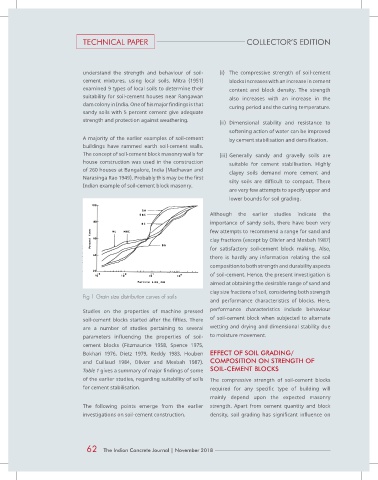
                              Fig 1 Grain size distribution curves of soils
                                                                            and performance characteristics  of blocks. Here,
                              Studies  on  the  properties  of  machine  pressed   performance  characteristics  include behaviour
                              soil-cement  blocks  started  after  the  fifties.  There   of soil-cement block when subjected to alternate
                              are  a number of studies  pertaining to  several   wetting and drying and dimensional stability due
                              parameters  influencing  the  properties  of  soil-  to moisture movement.
                              cement  blocks  (Fitzmaurice  1958,  Spence  1975,
                              Bokhari  1976,  Dietz  1979,  Reddy  1983,  Houben  EFFECT OF SOIL GRADING/
                              and  Cuillaud  1984,  Olivier  and  Mesbah  1987).  COMPOSITION ON STRENGTH OF

                              Table 1 gives a summary of major findings of some   SOIL-CEMENT BLOCKS
                              of the earlier studies, regarding suitability of soils   The compressive  strength of soil-cement  blocks
                              for cement stabilisation.                     required  for  any  specific  type  of  building  will
                                                                            mainly  depend upon the expected masonry
                              The following points emerge from the earlier   strength.  Apart  from  cement  quantity  and  block
                              investigations on soil-cement construction.   density,  soil  grading  has  significant  influence  on


                                62    The Indian Concrete Journal | November 2018

