


Page 77 - ICJ Jan 2023
P. 77
TECHNICAL PAPER                                            COLLECTOR’S EDITION


                              parent mix proportions were crushed, sieved and
                              stored separately. Four mixes of recycled concrete
                              were made with aggregates recycled from each of
                              the four parent mixes of concrete and tested for
                              28-day compressive strength.


                              RESULTS AND DISCUSSION
                              Properties of recycled aggregate

                              Particle size distribution
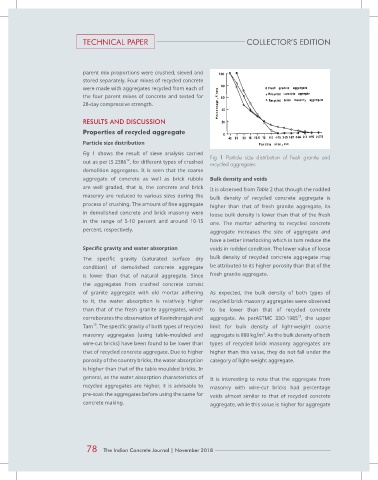
                              Fig  1  shows  the  result  of  sieve  analysis  carried   Fig 1 Particle size distribution of fresh granite and
                                              12
                              out as per IS 2386 , for different types of crushed   recycled aggregates
                              demolition aggregates. It is seen that the coarse
                              aggregate of concrete as well as brick rubble   Bulk density and voids
                              are well graded, that is, the concrete and brick   It is observed from Table 2 that though the rodded
                              masonry  are  reduced  to  various  sizes  during  the   bulk density  of recycled  concrete aggregate is
                              process of crushing. The amount of fine aggregate   higher than that of fresh granite  aggregate, its
                              in  demolished  concrete  and brick  masonry  were   loose bulk density is lower than that of the fresh
                              in  the  range  of  5-10  percent  and  around  10-15   one. The mortar adhering  to recycled concrete
                              percent, respectively.                        aggregate  increases  the  size  of  aggregate  and
                                                                            have a better interlocking which in tum reduce the
                              Specific gravity and water absorption         voids in rodded condition. The lower value of loose
                              The  specific  gravity  (saturated  surface  dry   bulk density  of  recycled  concrete  aggregate  may
                              condition)  of  demolished  concrete  aggregate   be attributed to its higher porosity than that of the
                              is  lower  than  that  of  natural  aggregate.  Since   fresh granite aggregate.
                              the aggregates from crushed concrete consist
                              of granite aggregate with old mortar adhering   As  expected,  the  bulk  density  of  both  types  of
                              to  it,  the  water  absorption is  relatively  higher   recycled brick masonry aggregates were observed
                              than  that  of  the  fresh  granite  aggregates,  which   to  be lower than that  of recycled  concrete
                              corroborates the observation of Ravindrarajah and   aggregate.  As  perASTMC  33O-1985 , the upper
                                                                                                           13
                                  10
                              Tam . The specific gravity of both types of recycled   limit  for bulk  density  of light-weight  coarse
                                                                                              3
                              masonry  aggregates  (using  table-moulded  and   aggregate is 880 kg/m . As the bulk density of both
                              wire-cut bricks) have been found to be lower than   types  of recycled brick masonry aggregates are
                              that of recycled concrete aggregate. Due to higher   higher than this value, they do not fall under the
                              porosity of the country bricks, the water absorption   category of light-weight aggregate.
                              is higher than that of the table moulded bricks. In
                              general, as the water absorption characteristics of   It is interesting to note that the aggregate from
                              recycled aggregates are higher, it  is advisable to   masonry with wire-cut  bricks had percentage
                              pre-soak the aggregates before using the same for   voids  almost  similar  to  that  of recycled  concrete
                              concrete making.                              aggregate, while this value is higher for aggregate


                                78    The Indian Concrete Journal | November 2018

