


Page 79 - ICJ Jan 2023
P. 79
TECHNICAL PAPER                                            COLLECTOR’S EDITION


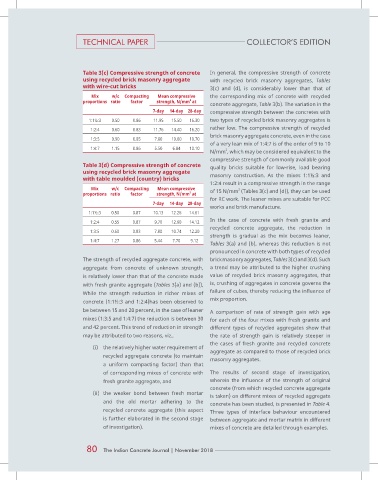
                              Table 3(c) Compressive strength of concrete   In general, the compressive strength of concrete
                              using recycled brick masonry aggregate        with  recycled  brick masonry aggregates,  Tables
                              with wire-cut bricks                          3(c)  and  (d),  is  considerably  lower  than  that  of

                                 Mix     w/c  Compacting   Mean compressive   the corresponding mix of concrete with recycled
                                                                    2
                              proportions ratio  factor  strength, N/mm  at  concrete aggregate, Table 3(b). The variation in the
                                                       7-day  14-day  28-day  compressive strength between the concretes with
                                 1:1½:3  0.50   0.86   11.95  15.50  16.30  two types of recycled brick masonry aggregates is
                                 1:2:4   0.60   0.83   11.76  14.40  16.20  rather low. The compressive strength of recycled
                                                                            brick masonry aggregate concrete, even in the case
                                 1:3:5   0.90   0.85    7.80  10.00  10.70
                                                                            of a very lean mix of 1:4:7 is of the order of 9 to 10
                                 1:4:7   1.15   0.86    5.50  6.84  10.10        2
                                                                            N/mm , which may be considered equivalent to the
                                                                            compressive strength of commonly available good
                              Table 3(d) Compressive strength of concrete   quality bricks suitable for low-rise, load bearing
                              using recycled brick masonry aggregate        masonry  construction.  As  the  mixes  1:1½:3  and
                              with table moulded (country) bricks
                                                                            1:2:4 result in a compressive strength in the range
                                 Mix     w/c  Compacting   Mean compressive           2
                                                                    2
                              proportions ratio  factor  strength, N/mm  at  of 15 N/mm  (Tables 3(c) and (d)), they can be used
                                                                            for RC work. The leaner mixes are suitable for PCC
                                                       7-day  14-day  28-day
                                                                            works and brick manufacture.
                                1:1½:3   0.50   0.87   10.13  12.26  14.61
                                 1:2:4   0.55   0.87    9.70  12.60  14.12  In  the  case  of concrete  with  fresh granite  and
                                                                            recycled  concrete  aggregate,  the  reduction  in
                                 1:3:5   0.60   0.83    7.80  10.74  12.20
                                                                            strength is  gradual as  the  mix  becomes leaner,
                                 1:4:7   1.27   0.86    5.44  7.70   9.12
                                                                            Tables 3(a) and (b), whereas this reduction is not
                                                                            pronounced in concrete with both types of recycled
                              The strength of recycled aggregate concrete, with   brick masonry aggregates, Tables 3(c) and 3(d). Such
                              aggregate from  concrete  of unknown strength,   a trend may be attributed to the higher crushing
                              is relatively lower than that of the concrete made   value of recycled brick masonry aggregates, that
                              with fresh granite aggregate (Tables 3(a) and (b)),   is, crushing of aggregates in concrete governs the
                              While the strength reduction in richer mixes of   failure of cubes, thereby reducing the influence of
                              concrete  (1:1½:3  and  1:2:4)has  been  observed  to   mix proportion.
                              be between 15 and 20 percent, in the case of leaner   A  comparison  of  rate  of  strength  gain  with  age
                              mixes (1:3:5 and 1:4:7) the reduction is between 30   for each of the four mixes with fresh granite and
                              and 42 percent. This trend of reduction in strength   different types of recycled aggregates show that
                              may be attributed to two reasons, viz.,       the  rate  of strength gain is  relatively  steeper in
                                                                            the cases of fresh granite  and recycled  concrete
                                  (i)  the relatively higher water requirement of   aggregate as compared to those of recycled brick
                                      recycled aggregate concrete (to maintain   masonry aggregates.
                                      a  uniform  compacting  factor)  than  that
                                      of  corresponding  mixes  of concrete  with   The results of second stage of investigation,
                                      fresh granite aggregate, and          wherein  the  influence  of  the  strength  of  original
                                                                            concrete (from which recycled concrete aggregate
                                  (ii)  the  weaker  bond  between  fresh  mortar   is taken) on different mixes of recycled aggregate
                                      and the old mortar adhering to the    concrete has been studied, is presented in Table 4.
                                      recycled  concrete  aggregate  (this  aspect   Three types of interface behaviour encountered
                                      is further elaborated in the second stage   between aggregate and mortar matrix in different
                                      of investigation).                    mixes of concrete are detailed through examples.


                                80    The Indian Concrete Journal | November 2018

