


Page 87 - ICJ Jan 2023
P. 87
POINT OF VIEW                                              COLLECTOR’S EDITION


                              The performance of concrete in bridge decks
                              serves  as  an  accelerated  field  test  for  durability,
                              because bridge decks are generally  exposed to
                              deicer  chemicals  and frequent cycles  of wetting-
                              drying,  heating-cooling,  and  freezing-thawing.  A
                              1987 report of the U.S. National Materials Advisory
                              Board made a startling observation that concrete
                              bridge  decks,  mostly  built  after  the  1940s,  were
                                                                        3
                              suffering from an epidemic of durability problems .
                              It was estimated that 253,000 bridge decks, some of
                              them less than 20 years old, were in varying states
                              of deterioration and that the number was growing
                              at the rate of about 35,000 bridge decks every year.


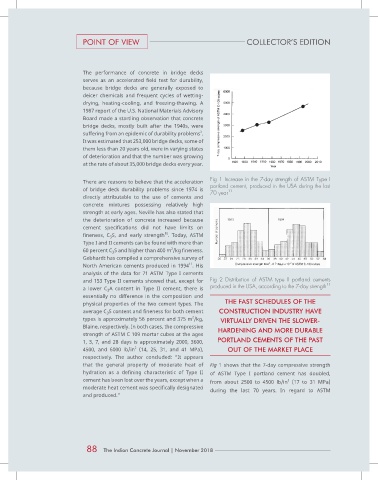
                              There are reasons to believe that the acceleration   Fig 1 Increase in the 7-day strength of ASTM Type I
                              of  bridge  deck  durability  problems  since  1974  is   portland cement, produced in the USA during the last
                                                                                  11
                                                                            70 year
                              directly  attributable to  the use of cements and
                              concrete mixtures possessing relatively  high
                              strength at early ages. Neville has also stated that
                              the deterioration of concrete increased because
                              cement  specifications  did  not  have  limits  on
                              fineness,  C S,  and  early  strength .  Today,  ASTM
                                                           10
                                        3
                              Type I and II cements can be found with more than
                              60 percent C S and higher than 400 m /kg fineness.
                                                              2
                                         3
                              Gebhardt has compiled a comprehensive survey of
                              North  American  cements  produced  in  1994 . His
                                                                    11
                              analysis  of  the  data  for  71  ASTM  Type  I  cements
                              and 153 Type II cements showed that, except for   Fig 2 Distribution of ASTM type II portland cements
                              a lower C A  content  in  Type  II  cement,  there  is   produced in the USA, according to the 7-day strength 11
                                       3
                              essentially  no difference in the composition and
                              physical properties of the two cement types. The   THE FAST SCHEDULES OF THE
                              average C S content and fineness for both cement   CONSTRUCTION INDUSTRY HAVE
                                       3
                                                                     2
                              types is approximately 56 percent and 375 m /kg,   VIRTUALLY DRIVEN THE SLOWER-
                              Blaine, respectively. In both cases, the compressive
                              strength of ASTM C 109 mortar cubes at the ages   HARDENING AND MORE DURABLE
                              1,  3,  7,  and  28  days  is  approximately  2000,  3600,   PORTLAND CEMENTS OF THE PAST
                                                 2
                              4500,  and  6000  lb/in   (14,  25,  31,  and  41  MPa),   OUT OF THE MARKET PLACE
                              respectively.  The author concluded:  “It  appears
                              that the general property of moderate heat of   Fig  1  shows  that  the  7-day  compressive  strength
                              hydration  as  a  defining  characteristic  of  Type  II   of  ASTM  Type  I  portland  cement  has  doubled,
                              cement has been lost over the years, except when a   from  about  2500  to  4500  lb/in   (17  to  31  MPa)
                                                                                                       2
                              moderate heat cement was specifically designated   during  the  last  70  years.  In  regard  to  ASTM
                              and produced.”


                                88    The Indian Concrete Journal | November 2018

