


Page 89 - ICJ Jan 2023
P. 89
POINT OF VIEW                                              COLLECTOR’S EDITION


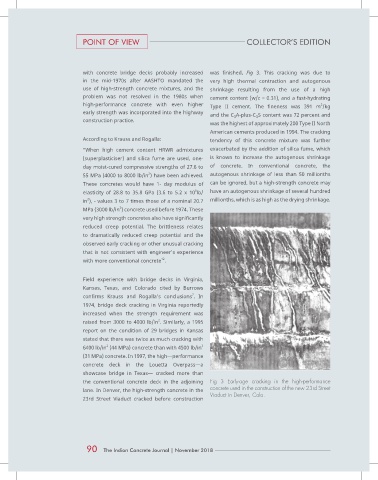
                              with concrete bridge  decks  probably increased   was  finished,  Fig 3.  This cracking was due to
                              in  the  mid-1970s  after  AASHTO  mandated  the   very  high thermal contraction and autogenous
                              use  of  high-strength concrete  mixtures,  and the   shrinkage  resulting from the use of a high
                              problem  was  not  resolved  in  the  1980s  when   cement content (w/c = 0.31), and a fast-hydrating
                              high-performance  concrete with even higher   Type  II  cement.  The  fineness  was  391  m /kg
                                                                                                                   2
                              early strength was incorporated into the highway   and the C A-plus-C S content was 72 percent and
                              construction practice.                                3       3
                                                                            was the highest of approximately 200 Type II North
                                                                            American cements produced in 1994. The cracking
                              According to Krauss and Rogalla:              tendency of this  concrete  mixture was further
                              “When  high  cement  content  HRWR  admixtures   exacerbated by the addition of silica fume, which
                              (superplasticiser)  and  silica  fume  are  used,  one-  is  known to  increase  the  autogenous shrinkage
                              day moist-cured compressive strengths of 27.6 to   of concrete. In conventional concrete, the
                                                      2
                              55 MPa (4000 to 8000 lb/in ) have been achieved.   autogenous  shrinkage  of  less  than  50  millionths
                              These  concretes  would  have  1-  day  modulus  of   can be ignored, but a high-strength concrete may
                                                                      6
                              elasticity  of  28.8  to  35.8  GPa  (3.6  to  5.2  x  10 lb/  have an autogenous shrinkage of several hundred
                                2
                              in ), - values 3 to 7 times those of a nominal 20.7   millionths, which is as high as the drying shrinkage.
                                           2
                              MPa (3000 lb/in ) concrete used before 1974. These
                              very high strength concretes also have significantly
                              reduced creep potential. The brittleness relates
                              to dramatically reduced  creep potential and  the
                              observed early cracking or other unusual cracking
                              that is not consistent with engineer’s experience
                                                          12
                              with more conventional concrete .

                              Field experience with bridge  decks in Virginia,
                              Kansas,  Texas,  and  Colorado  cited  by  Burrows
                                                                     7
                              confirms  Krauss  and  Rogalla’s  conclusions .  In
                              1974,  bridge  deck  cracking  in  Virginia  reportedly
                              increased when  the strength requirement was
                                                         2
                              raised  from  3000  to  4000  lb/in .  Similarly,  a  1995
                              report  on  the  condition  of  29  bridges  in  Kansas
                              stated that there was twice as much cracking with
                                                                         2
                                       2
                              6400 lb/in  (44 MPa) concrete than with 4500 lb/in
                              (31 MPa) concrete. In 1997, the high—performance
                              concrete  deck  in  the  Louetta  Overpass—a
                              showcase bridge in Texas— cracked more than
                              the  conventional  concrete  deck in  the  adjoining   Fig 3 Early-age cracking in the high-performance
                              lane. In Denver, the high-strength concrete in the   concrete used in the construction of the new 23rd Street
                                                                            Viaduct in Denver, Colo.
                              23rd  Street  Viaduct  cracked  before  construction


                                90    The Indian Concrete Journal | November 2018

