


Page 2 - July-Open-Access-2020
P. 2
TECHNICAL PAPER


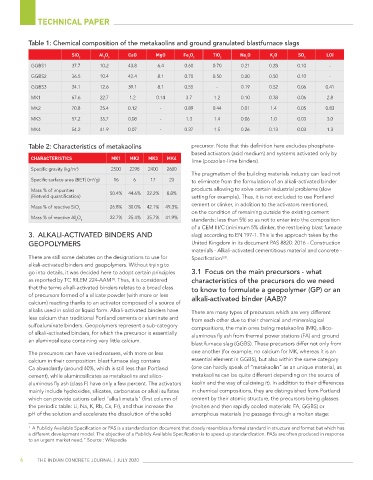
           Table 1: Chemical composition of the metakaolins and ground granulated blastfurnace slags

                         SiO      Al O      CaO       MgO      Fe O      TiO      Na O      K O       SO       LOI
                            2       2  3                         2  3      2        2        2          3
           GGbs1         37.7      10.2     43.8      6.4      0.60      0.70     0.21      0.28     0.10       -

           GGbs2         36.5      10.4     42.4      8.1      0.70      0.50     0.20      0.50     0.10       -
           GGbs3         34.1      12.6     39.1      8.1      0.55       -       0.19      0.52     0.06      0.41
           mK1           67.6      22.7      1.2      0.14      3.7      1.2      0.10      0.38     0.06      2.8
           mK2           70.8      25.4     0.12       -       0.89      0.44     0.01      1.4      0.05      0.83
           mK3           57.2      35.7     0.08       -        1.3      1.4      0.06      1.0      0.03      3.0

           mK4           54.2      41.9     0.07       -       0.37      1.5      0.26      0.13     0.03      1.3

           Table 2: Characteristics of metakaolins                precursor. Note that this definition here excludes phosphate-
                                                                  based activators (acid medium) and systems activated only by
           ChARACTERISTICS             MK1   MK2   MK3   MK4      lime (pozzolan-lime binders).
           Specific gravity (kg/m )    2500  2298  2400  2600
                           3
                                                                  The pragmatism of the building materials industry can lead not
           Specific surface area (BET) (m /g)  16  6  17  23      to eliminate from the formulation of an alkali-activated binder
                                2
           mass % of impurities       50.4%  44.6%  22.2%  8.8%   products allowing to solve certain industrial problems (slow
           (Rietveld quantification)                              setting for example). Thus, it is not excluded to use Portland
                                                                  cement or clinker, in addition to the activators mentioned,
           mass % of reactive siO     26.8%  30.0%  42.1%  49.3%
                            2
                                                                  on the condition of remaining outside the existing cement
           mass % of reactive al O    22.7%  25.4%  35.7%  41.9%
                           2  3                                   standards: less than 5% so as not to enter into the composition
                                                                  of a CEm III/C (minimum 5% clinker, the rest being blast furnace
           3.  ALKALI-ACTIVATED BINDERS AND                       slag) according to EN 197-1. This is the approach taken by the
           GEOPOLYMERS                                            United Kingdom in its document Pas 8820: 2016 - Construction
                                                                  materials - alkali-activated cementitious material and concrete -
           There are still some debates on the designations to use for   Specification .
                                                                             [2]1
           alkali-activated binders and geopolymers. Without trying to
           go into details, it was decided here to adopt certain principles   3.1  Focus on the main precursors - what
           as reported by TC RILEm 224-aam . Thus, it is considered   characteristics of the precursors do we need
                                        [1]
           that the terms alkali-activated binders relates to a broad class   to know to formulate a geopolymer (GP) or an
           of precursors formed of a silicate powder (with more or less   alkali-activated binder (AAB)?
           calcium) reacting thanks to an activator composed of a source of
           alkalis used in solid or liquid form. alkali-activated binders have   There are many types of precursors which are very different
           less calcium than traditional Portland cements or aluminate and   from each other due to their chemical and mineralogical
           sulfoaluminate binders. Geopolymers represent a sub-category   compositions, the main ones being metakaolins (mK), silico-
           of alkali-activated binders, for which the precursor is essentially   aluminous fly ash from thermal power stations (FA) and ground
           an aluminosilicate containing very little calcium.
                                                                  blast furnace slag (GGbs). These precursors differ not only from
           The precursors can have varied natures, with more or less   one another (for example, no calcium for mK, whereas it is an
           calcium in their composition: blast furnace slag contains   essential element in GGbs), but also within the same category
           Ca abundantly (around 40%, which is still less than Portland   (one can hardly speak of “metakaolin” as an unique material, as
           cement), while aluminosilicates as metakaolins and silico-  metakaolins can be quite different depending on the source of
           aluminous fly ash (class F) have only a few percent. The activators   kaolin and the way of calcining it). In addition to their differences
           mainly include hydroxides, silicates, carbonates or alkali sulfates   in chemical compositions, they are distinguished from Portland
           which can provide cations called "alkali metals" (first column of   cement by their atomic structure, the precursors being glasses
           the periodic table: Li, Na, K, Rb, Cs, Fr), and thus increase the   (molten and then rapidly cooled materials: Fa, GGbs) or
           pH of the solution and accelerate the dissolution of the solid   amorphous materials (no passage through a molten stage:


           1   A Publicly Available Specification or PAS is a standardization document that closely resembles a formal standard in structure and format but which has
           a different development model. The objective of a Publicly Available Specification is to speed up standardization. PASs are often produced in response
           to an urgent market need.” source : Wikipedia


        6     The IndIan ConCreTe Journal | JulY 2020

